



The Training Worked. The Culture Did Not Change.
For the leader who funded the program, filled the room, finished the workbook, and watched the culture settle back exactly where it was. The gap is not effort. It is the system underneath the training. Tri-sector.
▶ Listen instead · 55 secondsThe training worked. The culture did not change. Here is why.
You did everything right. You picked a strong program, you protected the time, your people leaned in, and for a week the language was everywhere. Then the quarter pulled everyone back, and within a month the room looked exactly like it did before. So most leaders book the next program. The behavior decays again, because the problem was never the training. It was the system the training was supposed to change, and a workshop cannot change a system. By the end of this Culture Insight you will have a sharper way to read the gap, and the structural reason more training never closes it.
Sources: ATD, summarizing Newstrom, for the training-transfer curve; Gallup, State of the Global Workplace 2024, for the cost of disengagement.
What you will walk away with
- Why behavior decays after training, and the exact point it slides back
- The difference between training completion and culture change, and how to measure the second one
- A training-to-change check you can run on your own team this week
1 · A culture is held by its system
Culture is not what a program teaches. It is what the system around your people models, measures, rewards, and tolerates every single day. Training adds new language and new intentions on top of that system. The system is older, heavier, and always on. When the two disagree, the system wins, because it is the thing your people actually live inside.
That is why the change feels real for a week and then fades. The workshop raised awareness. Nothing underneath it moved. The same metrics, the same incentives, the same meetings, and the same tolerated behavior were all waiting on Monday, and they quietly pulled everyone back to where they started.
▸The pattern: behavior reverts to what the system rewards, not what the workshop taught, and the slide back starts within weeks.
The hidden cost
Every program that fades teaches your people something you did not intend, that change here is a season and not a commitment. The next initiative is met with a little more quiet. Your best people, the ones who actually tried to apply it, are the first to read the signal.
Tri-sector
This is identical in a Fortune 500 division, a county department, and a school district cabinet. The labels change. The distance between what was trained and what the system keeps does not.
Her own words, from the field: "More training is not the answer. Systems-level leadership and culture realignment is."
What the training changed
- Awareness went up
- New language entered the room
- Intentions were set
- Energy was high on day one
What the system kept the same
- The same metrics and targets
- The same incentives and rewards
- The same tolerated behavior
- The same daily pressure
The system is always on, so it wins. Behavior reverts to what the structure rewards, not what the workshop taught.
The same training-to-change gap, read in three sectors
2 · Why the behavior decays
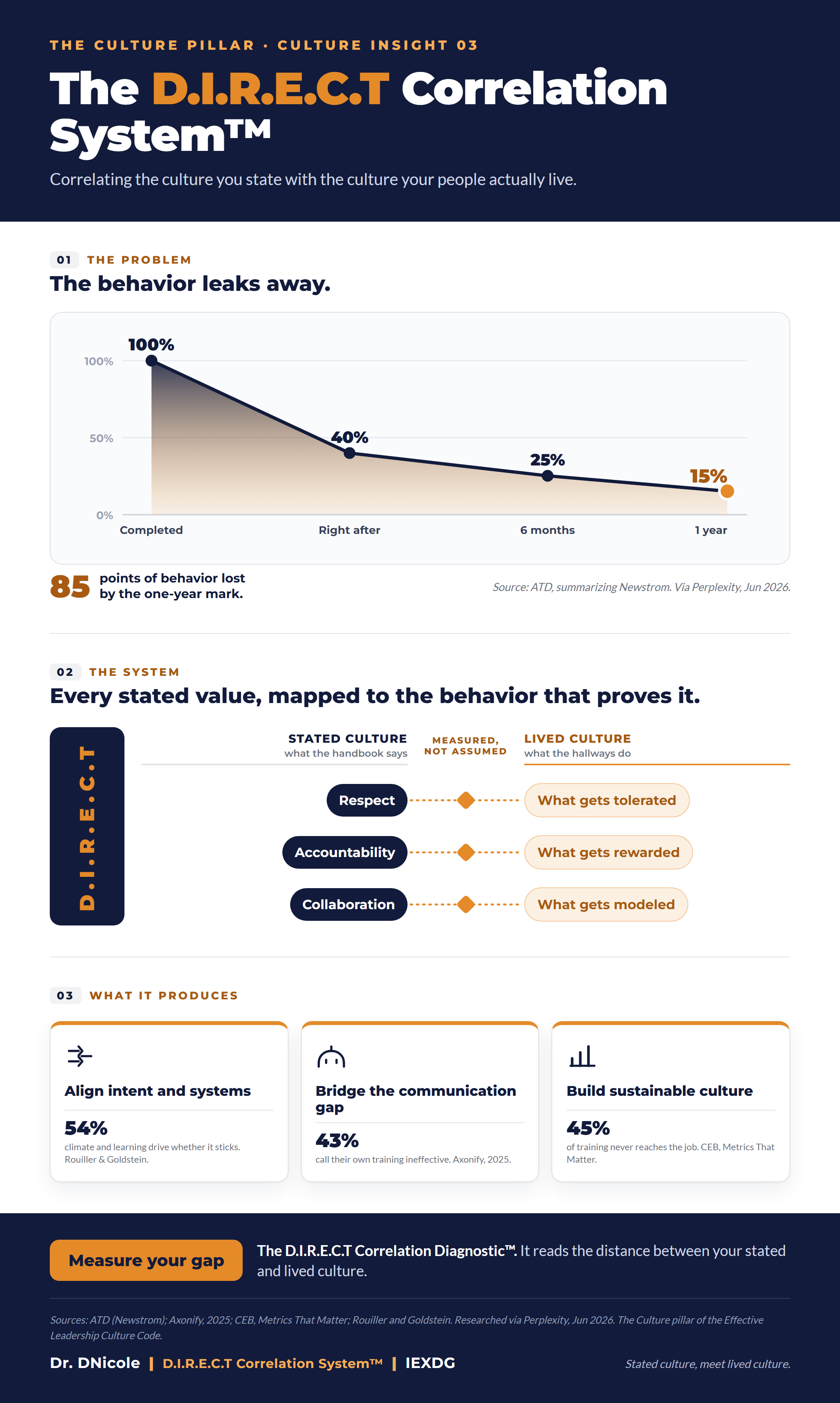
Watch what happens after a good program. On day one, about 40 percent of the new skill is actually in use. Six months later, without anything in the system to hold it, that is down to roughly 25 percent. At a year it is near 15 percent. Nobody decided to abandon the training. The system simply kept rewarding the old behavior, and people are rational. They do what the structure pays them to do.
The people who actually tried to apply the training are the ones who feel the slide first. They watched it work, then watched the system quietly erase it, and they learn that effort here does not compound. That is the moment a strong performer starts listening to other offers, because nothing in the room rewards the change they were asked to make.
▸The pattern: when the training fades and the system stays the same, your people learn that change here does not last, and your best ones learn it first.

The structural fix
If the change keeps fading, do not start with another program. Start with the system. Ask what your metrics actually reward, what behavior gets tolerated on a hard week, and what the daily structure pulls people back to. That is where the change has to be built, because that is where your people actually live.
Source: Gallup, State of the Global Workplace 2024. Disengagement costs the global economy about $8.9 trillion, roughly 9 percent of GDP. Gallup also finds 42 percent of turnover is preventable, and replacing a leader runs about 200 percent of their salary. The quiet is not peace. It is the data.
3 · The change the training cannot reach
A program can reach a person's awareness and a person's skill. It cannot reach the things that actually govern behavior on a Tuesday: the metrics you are measured on, the incentives that pay out, the behavior that gets tolerated under pressure, and the meetings that fill the week. Those live in the system, around and above the training, and they are what people actually obey.
So the work is not a better workshop. It is changing the conditions the behavior lives in. Name the few system signals that really drive the behavior you want. Change what gets measured and rewarded so the new behavior pays instead of costs. Make the standard visible and reinforced in the daily structure, not just in the deck. Then the training has something to stand on, and the change has a reason to stay.
None of this replaces good training. It is what makes good training hold. A workshop on top of an unchanged system is a cost that repeats. The same workshop on top of a changed system is an investment that compounds.
▸The pattern: training reaches the person, the system holds the culture, and only the second one keeps the change.
From the field: "Most organizations are running leadership programs on top of a broken culture."
Key diagnostic takeaways
- Behavior reverts to what the system rewards, not what the workshop taught.
- Only about 15 percent of trained skill still shows a year later, without reinforcement in the system.
- The fix is not another program. It is changing the system the behavior lives in.
Another program vs the structural fix
Most leaders reach for more training because it is familiar, not because it fits. This table is a diagnostic, not a verdict. If you have mostly tried the left column and the results still land short, the right column is worth examining. The score reads 1 when an approach treats the symptom only, and 10 when it reaches the structural root.
| Dimension | Another training or offsite | Structural culture-system intervention (IEXDG) | Score |
|---|---|---|---|
| What it treats | A skills gap in the people | The system that erases the training | 9/10 |
| What it changes | Adds awareness that fades within months | Changes the metrics, incentives, and structure that hold behavior | 9/10 |
| What happens after | Behavior decays to about 15 percent in a year | The new behavior is reinforced, so it stays | 9/10 |
| Who pays | You fund the next program, and the one after that | The first investment compounds instead of repeating | 10/10 |
What to expect
What your 90 days looks like
Ready to start at Step 1? A 30 minute Clarity Call. No fee. No deck. Just diagnosis.
Book a Clarity CallCost and return
Pricing tracks scope, not seat count. The diagnostic is the front door, and every tier returns a SWOT and three structural fixes you can take to your board.
| Engagement | Scope | Best for |
|---|---|---|
| Enterprise, multi-entity | Custom | Multi-department or multi-site culture rebuild |
| Departmental engagement | Expanded | Several teams, broader and deeper |
| Leadership Culture Intelligence Session | Single team | The focused entry diagnostic |
| D.I.R.E.C.T Correlation Diagnostic | Lighter read | A faster first look |
| Clarity Call | No fee | Naming the real gap |
Every engagement is scoped to your organization on the Clarity Call and priced to fit. The cost of doing nothing is usually the larger number.
For a budget conversation: IEXDG engagements are scoped to produce board-reportable outcome data within 90 days, which makes them defensible at the quarterly budget level.
The cost of doing nothing
Sources: Gallup, State of the Global Workplace 2024 ($8.9 trillion, 18 percent of salary per disengaged employee). Center for American Progress (replacement cost up to 213 percent of salary). Gallup places manager and leader replacement near 200 percent of salary.
Where IEXDG sits against the market
| Where the spend usually goes | Typical market cost |
|---|---|
| Big 4 or strategy firm culture and leadership work | $2,800 to $8,000 plus per day, six to seven figures total |
| Boutique culture project | $5,000 to $50,000, an assessment alone often over $20,000 |
| Engagement-survey platform, per year | $15,000 to $150,000 plus for 250 to 1,000 people |
| IEXDG, scoped to your gap | Named on the Clarity Call, a SWOT and three fixes in 5 to 7 days |
Market ranges from published consulting and HR-platform pricing (Center for American Progress, SHRM, Perceptyx, Culture Amp, and comparable firms). IEXDG is scoped to your organization, so the number fits the work, not a list.
Questions leaders ask
- Why does leadership training fail to change culture?
- Training teaches individuals, but culture is held by the system around them: what gets modeled, measured, rewarded, and tolerated every day. When the system stays the same, the behavior decays. Research on training transfer finds only about 15 percent of trained skill still shows a year later. The program worked. The structure that would hold the change was never built.
- If the training was good, why did nothing change?
- A good program raises awareness, then daily reality pulls people back. Without reinforcement in the system, about 40 percent of trained skill is gone within six months and only about 15 percent remains at a year. The fix is not a better workshop. It is changing the conditions the behavior lives in.
- How do you measure culture change instead of training completion?
- Completion is a checkbox. Change is measured in lived experience: whether the stated culture matches the experienced one across the six conditions a healthy culture is built on. The D.I.R.E.C.T Correlation Diagnostic scores that gap directly, in a short confidential read, so you are tracking change, not attendance.
- Is the answer just more training?
- No. More training on top of an unchanged system produces the same decay. The answer is a culture system that makes the change measurable and reinforced, which is the work of the D.I.R.E.C.T Correlation System inside the Culture pillar.
- How fast does the D.I.R.E.C.T Correlation Diagnostic show the gap?
- The D.I.R.E.C.T Correlation Diagnostic is a short, confidential, scored read that returns where your stated culture and your experienced culture diverge, plus the structural fixes that close it, not a dashboard you watch forever.
- Does this apply to government and education?
- Yes. The training-to-change gap is identical in a corporate division, a government agency, and a school district. The labels change. The decay does not. The work crosses all three sectors.
About IEXDG
Dr. DNicole Fields, Ed.D., is a leadership and organizational culture strategist with more than twenty years across the corporate, government, and education sectors. IEXDG is built on the Effective Leadership Culture Code®, her proprietary six-pillar framework, and on system-driven delivery: diagnostic to SWOT in 5 to 7 days, the Culture Diagnostic scoped to your organization. The work spans leadership teams across all three sectors.
IEXDG does not use testimonial language or motivational framing in its published work. The results speak through diagnostic data, not endorsements.
Related
Strong Team. Wrong Results.
The companion insight on the gap between the bar you state and the bar your team actually performs to.
I Wore a Heart Monitor to Work
The companion insight on the gap between what leadership says and what the team actually lives.
The D.I.R.E.C.T Correlation Diagnostic™
The diagnostic that reads where your stated and lived culture diverge, then returns a SWOT and three structural fixes.
Take the Correlation Diagnostic
Answer three questions and get a score across the six conditions of leadership culture, the exact gap named, and three fixes you can start this week. Then a short call to read the result together. No deck, no pitch.
Take the 3-minute diagnosticIf this sounds familiar, it is not a reflection of your team's effort or the program you chose. It is the system the new behavior had nowhere to live in. The D.I.R.E.C.T Correlation Diagnostic is built to surface exactly where that gap sits in your organization. No report you watch forever. A diagnostic conversation.
Clarity Calls are available this week. 30 minutes. No pitch.