



Coaching vs Culture Change: What to Buy When
For the leader weighing the next invoice. Coaching changes the person. Only the system changes the culture. Buy the familiar tool for a problem that is actually structural, and the program works while the culture does not move. Tri-sector.
▶ Listen instead · 55 secondsCoaching changes the person. Only the system changes the culture. Here is what to buy when.
You saw a behavior you did not like, so you bought the tool that felt like action. Coaching for the leader. A program for the team. It worked in the room, and for a few weeks the language was everywhere. Then the quarter pulled everyone back and the behavior returned, because the thing you bought reached a person and the thing that was broken was the system. A workshop cannot change a system, and coaching cannot out-talk a structure that pays for the old behavior. By the end of this Culture Insight you will be able to read the depth of your own problem, and match it to the one tool that actually fits, before you spend again.
Sources: field observation.
What you will walk away with
- The difference between a person problem and a system problem, and why coaching only fixes the first
- A four-depth map that matches the problem you actually have to the tool that fits it
- A 60-second check you can run on your last program before you buy the next one
1 · What you are actually buying
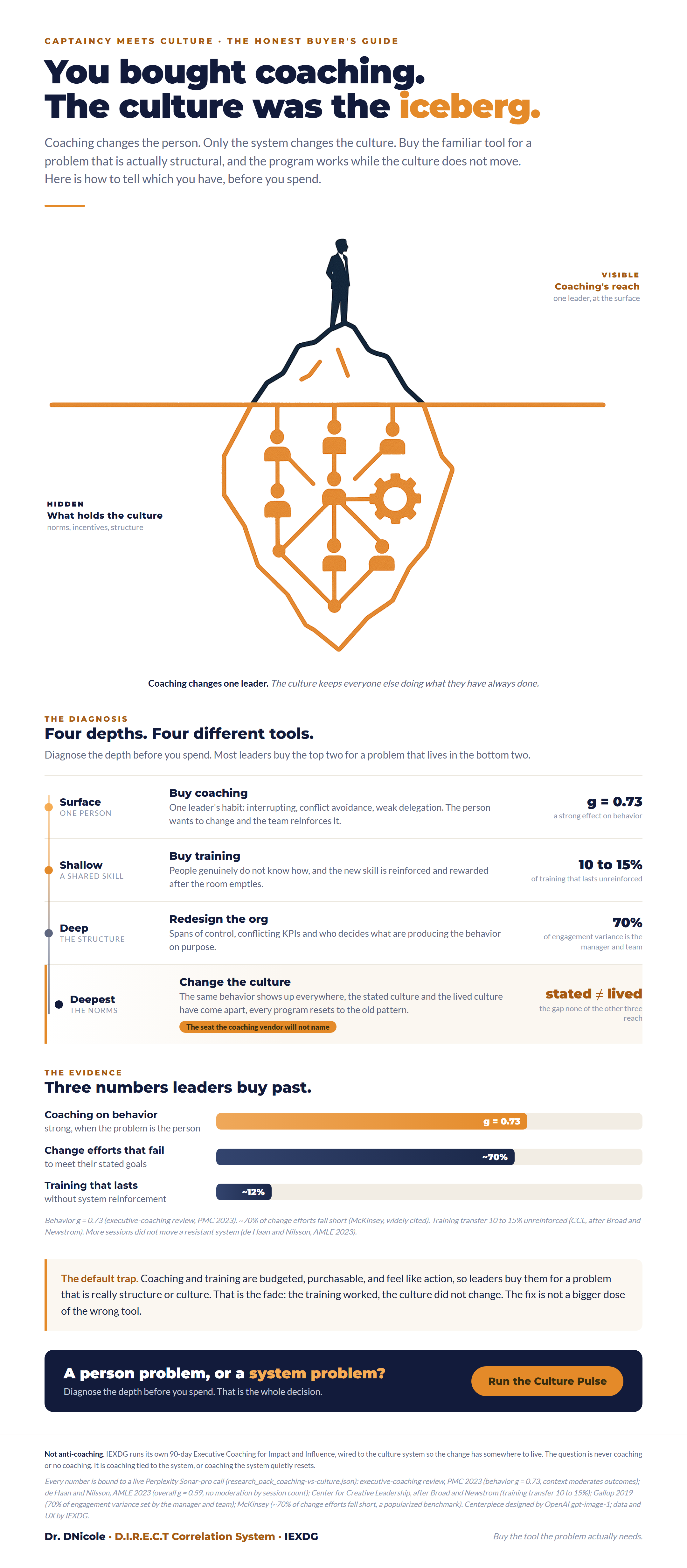
Picture the problem as an iceberg. At the surface, in the light, is one leader's behavior. That is the part coaching can reach, and it reaches it well. Below the waterline, much larger and out of sight, is the system: the metrics people are measured on, the incentives that pay out, who gets to decide what, and the behavior that gets tolerated on a hard week. That submerged mass is the culture, and it is what your people actually obey. Coaching buys the tip. The problem is usually the iceberg.
This is why the tool you reach for matters more than the effort you put in. A leader can want to change, do the work in the session, and still get pulled back, because nothing below the line moved. The behavior did not fail. The tool was scoped to the wrong depth. The most expensive mistake in this whole category is buying a surface tool for a problem that lives at the bottom, then buying it again when it fades.
▸The pattern: coaching reaches the person, the system holds the culture, and most leaders buy the first for a problem that is really the second.
Her own words, from the field: "Most organizations are running leadership programs on top of a broken culture."
The same buying decision, read in three sectors
2 · Why coaching fades against a system
Coaching is strong at what it is built for. Across controlled studies its effect on a leader's behavior is large when the problem really is that person's habit. But the same body of research is honest about its boundary. The overall effect does not depend much on the number or length of sessions, and context, the organizational setting around the coachee, significantly moderates whether anything sticks. In plain terms: you cannot buy your way past a resistant system with more sessions. The system is the variable.
So the fade is not a coaching failure. It is a depth mismatch. When the behavior is held by the structure, coaching lifts the person for as long as the attention lasts, then the structure quietly pulls them back to what it rewards. The leader who tried hardest feels it first, and learns that effort here does not compound. That is the moment a strong performer starts to drift, not because the coaching was weak, but because the system around it never changed.
▸The pattern: coaching changes the person, the system changes them back, and more sessions do not move a structure that rewards the old behavior.

The structural fix
If the change keeps fading, do not buy another dose of the same tool. Name the few system signals that actually drive the behavior, what gets measured, what pays out, what gets tolerated under pressure. Change those so the new behavior is the one that wins. Then coaching, used for the right person at the right depth, finally has somewhere to land.
3 · How to tell which you have
The whole decision is a depth read. Ask one question before you spend: is this the person, or the system? If it is genuinely one leader's habit and the team will reinforce the change, buy coaching, and expect it to work. If people honestly do not know how and the new skill will be rewarded afterward, buy training. If roles, incentives and decision rights are producing the behavior on purpose, redesign the org. And if the same behavior shows up everywhere, if the culture you state and the culture your people live have come apart, and if every program resets to the old pattern, then the work is the culture itself, and that is the one the other three tools cannot reach.
That deepest layer is the work of the Culture pillar. The D.I.R.E.C.T Correlation System reads where your stated culture and your lived culture diverge, names the system that holds the gap, and produces the structural fixes that change it. The buying decision itself, the judgment about which tool fits which depth, is Captaincy: the discipline of the D.I.P.L.O.M.A Synergy System, leading by deciding well instead of deciding by default. Coaching is not the enemy here. Buying it for the wrong depth is.
None of this is anti-coaching. IEXDG runs its own 90-day Executive Coaching for Impact and Influence, but wired to the culture system so the change has somewhere to live. The question is never coaching or no coaching. It is coaching tied to the system, or coaching the system quietly resets.
▸The pattern: diagnose the depth first, then buy the one tool that fits it. The budget is not the lever, the depth is.
From the field: "More training is not the answer. Systems-level leadership and culture realignment is."
Key diagnostic takeaways
- Coaching is strong on a person's behavior and weak against a system that resets it.
- More sessions do not move a resistant system, and most of what is trained does not last without reinforcement.
- The tool follows the depth. Surface to coaching, norms to culture change. Most leaders buy the top for a problem at the bottom.
More coaching or training vs the structural fix
Most leaders reach for another program because it is familiar, not because it fits the depth. This table is a diagnostic, not a verdict. If you have mostly tried the left column and the behavior still resets, the right column is worth examining. The score reads 1 when an approach treats the surface only, and 10 when it reaches the structural root.
| Dimension | More coaching or another program | Structural culture-system intervention (IEXDG) | Score |
|---|---|---|---|
| What it treats | One person's behavior, or awareness in a room | The system that resets the behavior across the team | 9/10 |
| What it changes | Lifts the person while attention lasts | Changes the metrics, incentives, and structure that hold behavior | 9/10 |
| What happens after | The structure pulls the behavior back | The new behavior is reinforced, so it stays | 9/10 |
| Who pays | You fund the next dose, and the one after that | The first investment compounds instead of repeating | 10/10 |
What to expect
What your 90 days looks like
Ready to start at Step 1? A 30 minute Clarity Call. No fee. No deck. Just diagnosis.
Book a Clarity CallCost and return
Pricing tracks scope, not seat count, and not the tool you walked in expecting to buy. The diagnostic is the front door, and every tier returns a SWOT and three structural fixes you can take to your board.
| Engagement | Scope | Best for |
|---|---|---|
| Enterprise, multi-entity | Custom | Multi-department or multi-site culture rebuild |
| Departmental engagement | Expanded | Several teams, broader and deeper |
| Leadership Culture Intelligence Session | Single team | The focused entry diagnostic |
| D.I.R.E.C.T Correlation Diagnostic | Lighter read | A faster first look |
| Clarity Call | No fee | Naming the real depth |
Every engagement is scoped on the Clarity Call and priced to fit. The cost of buying the wrong-depth tool twice is usually the larger number.
For a budget conversation: IEXDG engagements are scoped to produce board-reportable outcome data within 90 days, which makes them defensible at the quarterly budget level.
The cost of buying the wrong depth
Sources: Gallup, State of the Global Workplace 2024 ($8.9 trillion).
Where the spend usually goes
| Where the spend usually goes | Typical market cost |
|---|---|
| Executive coaching, per leader per year | $10,000 to $100,000 plus, scoped to one person |
| Leadership program or offsite | $5,000 to $50,000, awareness that fades without reinforcement |
| Engagement-survey platform, per year | $15,000 to $150,000 plus, measures the gap without closing it |
| IEXDG, scoped to your depth | Named on the Clarity Call, a SWOT and three fixes in 5 to 7 days |
Market ranges from published coaching and HR-platform pricing. IEXDG is scoped to the depth of your problem, so the number fits the work, not a list.
Questions leaders ask
- Coaching or culture change, what is the difference?
- Coaching changes one person's behavior. Culture change alters the system that many people share: what gets modeled, measured, rewarded, and tolerated. Executive coaching has a strong effect on a leader's behavior when the problem really is the person. When the same behavior shows up across the team, the problem is the system, and coaching cannot reach it.
- Why did the coaching not change anything?
- Because coaching effectiveness depends on the system around the coachee. Research finds context and organizational setting significantly moderate outcomes, and that more sessions do not help against a system that resets the behavior. The person changed, then the unchanged system changed them back.
- When should I buy coaching, and when should I buy something else?
- Diagnose the depth first. One leader's habit, buy coaching. A genuine shared skill gap that will be reinforced, buy training. Roles, incentives and decision rights producing the behavior, redesign the org. The same behavior everywhere and a gap between the stated and lived culture, change the culture. Most leaders buy the top two for a problem that lives in the bottom two.
- Does more training fix a culture problem?
- No. Most of what is trained does not survive contact with the job. More training on an unchanged system buys more of the same fade. The fix is changing the conditions the behavior lives in, then training into them.
- Is IEXDG against coaching?
- No. IEXDG runs its own 90-day Executive Coaching for Impact and Influence, but wired to the culture system so the change has somewhere to live. The question is never coaching or no coaching. It is coaching tied to the system, or coaching the system quietly resets.
- How do I tell if my problem is the person or the system?
- The D.I.R.E.C.T Correlation Diagnostic reads where your stated culture and your lived culture diverge across the six conditions of a healthy culture, and returns a SWOT with three structural fixes. It answers the one question the vendor will not ask before you spend: is this the person, or the system?
About IEXDG
Dr. DNicole Fields, Ed.D., is a leadership and organizational culture strategist with more than twenty years across the corporate, government, and education sectors. IEXDG is built on the Effective Leadership Culture Code®, her proprietary six-pillar framework, and on system-driven delivery: diagnostic to SWOT in 5 to 7 days, the Culture Diagnostic scoped to your organization. The work spans leadership teams across all three sectors.
IEXDG does not use testimonial language or motivational framing in its published work. The results speak through diagnostic data, not endorsements.
Related
The Training Worked. The Culture Did Not Change.
The companion insight on why a good program fades, and where the change actually has to be built.
Strong Team. Wrong Results.
The gap between the bar you state and the bar your team actually performs to.
The D.I.R.E.C.T Correlation Diagnostic™
The diagnostic that reads where your stated and lived culture diverge, then returns a SWOT and three structural fixes.
Take the Correlation Diagnostic
Answer three questions and get a score across the six conditions of leadership culture, the exact gap named, and three fixes you can start this week. It answers the one question to settle before you spend: is this the person, or the system?
Take the 3-minute diagnosticIf this sounds familiar, it is not a reflection of the coaching you bought or the effort your team gave. It is a tool scoped to the wrong depth. The D.I.R.E.C.T Correlation Diagnostic is built to surface exactly which depth your problem lives at, before you spend again. No report you watch forever. A diagnostic conversation.
Clarity Calls are available this week. 30 minutes. No pitch.