



The AI Worked. The Work Did Not Change.
For the leader who bought the AI, trained the team, and six months later is looking at work that looks exactly like it did before. The tool is not the thing that failed. The behavior around it never moved, because the old way is still what gets rewarded.
▶ Listen instead · 60 secondsThe AI worked. The work did not change. Most enterprise AI rollouts fail on leadership behavior and culture, not the technology. Here is why.
The tool went live. The demo was clean, the team was trained, and the room nodded like something had been solved. Six months later the reports read the same, the meetings run the same, and the work looks exactly like it did before the license was signed. The model was not wrong. It did what it was built to do. It was silent about the thing that decides whether anything changes, which is the behavior around it, and that is the part no rollout plan carried.
Sources: MIT Project NANDA, The GenAI Divide (2025); RAND Corporation (2024); S&P Global Market Intelligence (2025).
What you will walk away with
- Why a tool that works can still change nothing about how the work gets done
- The four places a stalled rollout quietly bills you, with current numbers
- The six-pillar read that names which part of your culture the rollout is actually dying on
1 · What actually failed
Start with the honest part. The technology usually works. RAND found that the single most common cause of AI project failure is not the model at all, it is miscommunication about the intent and purpose of the project, and that the biggest single challenge is the absence of AI-ready data. Both of those are organizational, not algorithmic (RAND Corporation, 2024). The tool did the thing it was built to do. The organization around it did not do the thing that would have made the tool matter.
So a company buys the capability, trains the team, and watches the work stay exactly where it was, because the behavior the tool was supposed to change was never rewarded differently, never modeled by the people who mandated it, and never named as the actual point. The license was the input. The change was supposed to start after, and it did not, because nothing about how the place runs was asked to move.
▸The pattern: a new tool changes what is possible. It does not change what is rewarded. When the old way is still what the system pays for, people keep doing the old way and route the new tool around the edges.
Her own words, from the field: "The tool was never the answer. It was the mirror. It showed you the behavior you already had, faster. The work is changing the behavior."
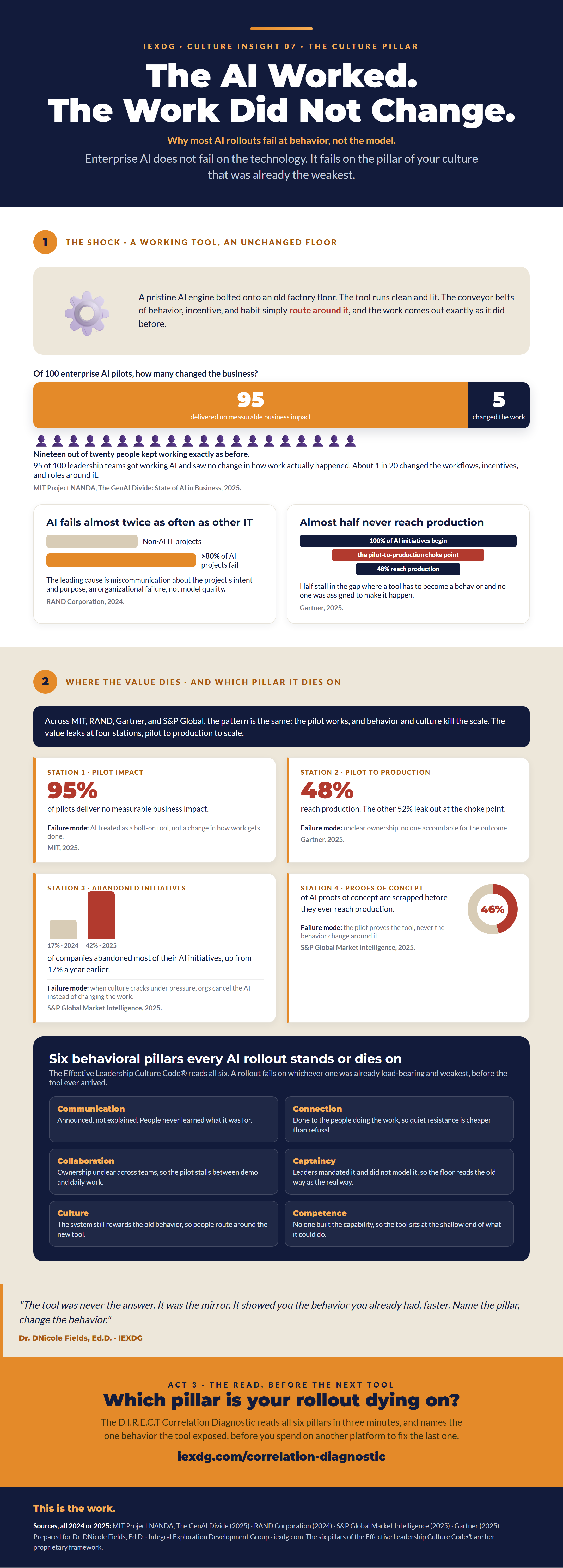
The same stall, read in three sectors
2 · Four ways a stalled rollout bills you, quietly
Nobody writes "the AI did not change anything" on a budget line. It still gets paid, in four places, and the numbers are current and neutral.
3 · Why it compounds
The number that stops me is not the failure rate, it is the comparison. AI projects fail at roughly twice the rate of non-AI IT projects, and the leading cause is not the model, it is miscommunication about what the project was even for. The more senior the sponsor who announced it without living it, the wider the gap between the launch slide and the floor, because everyone below reads what leadership actually does, not what leadership bought.
▸The pattern: a stalled rollout does not stay a technology line item. It scales with the distance between what leaders mandated and what leaders model, and that distance is a culture measurement, not a software one.
RAND Corporation, 2024.

4 · It is not a tools problem. It is a culture read.
This is the whole turn. A new tool changes what is possible. It does not change what is rewarded, modeled, or tolerated, and those three are culture, not software. An AI rollout does not fail everywhere at once. It fails on the pillar that was already the weakest, and that pillar is nameable. The Effective Leadership Culture Code® reads an organization across six of them, and each one is a specific way a rollout dies:
The six pillars of the Effective Leadership Culture Code® (ELCC), Dr. DNicole Fields.
▸The pattern: buying a tool asks one question, does it work. Adopting it asks six, one per pillar, and the rollout dies on whichever pillar was load-bearing and weakest before the tool ever arrived.
Buying a tool next to reading the culture
Most organizations answer a stalled rollout by buying a different tool, because a tool is familiar and it has a purchase order. This is a diagnostic, not a verdict. If you have only ever run the left column, the right column is worth three minutes.
| Dimension | Buying another tool | The D.I.R.E.C.T Correlation Diagnostic™ |
|---|---|---|
| What it addresses | The capability, on the assumption the last tool was the problem | The behavior the tool exposed, across the six pillars of your culture |
| What it changes | What is possible | What is rewarded, modeled, and tolerated |
| Where it works | Anywhere, which is why the same rollout stalls the same way twice | Your organization's specific weakest pillar, the one the rollout keeps dying on |
| What you leave with | A new license and the same result | A read of which pillar is load-bearing and weakest, and where stated and lived culture diverge |
What to expect
- Start with the free read. The D.I.R.E.C.T Correlation Diagnostic is three minutes across the six pillars. It returns which pillar is your load-bearing weakness, the one a rollout will stall on.
- Go deeper only if the read warrants it. The Leadership Culture Scan is the paid, thirty-question instrument that scores all six pillars in detail and returns your tier and your lowest pillar.
- The finding, not a pitch. You leave knowing which behavior the tool exposed, in your own language, not a generic maturity model.
- The Monday move, the one change to what gets rewarded or modeled that unsticks the rollout you already paid for.
- The path to the full engagement if the weakest pillar runs deep enough to need structural work, not another tool.
Cost and return
The diagnostic is three minutes and free. The rollout it reads is one of the 95 percent that deliver no measurable impact, on top of a spend that already cleared, before the next tool you were about to buy to fix the last one. The return is not soft. It is the difference between an organization that keeps buying tools and one that changes the behavior the tools keep exposing.
Who is behind this
IEXDG is a leadership and organizational culture development ecosystem built on owned intellectual property and measurable, system-driven delivery. Dr. DNicole Fields, Ed.D., works across corporate, government, and education, and the ELCC 6-Pillar Framework is her proprietary model: Communication, Connection, Collaboration, Captaincy, Culture, and Competence. The D.I.R.E.C.T Correlation Diagnostic reads all six in three minutes. No maturity-model theater, no vendor pitch. It ends with which pillar to work.
For media inquiries, or to cite IEXDG research in your work, contact [email protected].
Related
Coaching vs Culture Change: What to Buy When
The twin of this piece. The training worked and the culture did not change, for the same reason the AI works and the work does not. How to match the fix to the depth the problem lives at.
Everyone Took the Assessment. The Team Still Missed Each Other.
An assessment names how your people communicate, not what to do when two styles collide. The Communication pillar, one of the six a rollout can die on.
The D.I.R.E.C.T Correlation Diagnostic™
Read all six pillars at once and see which one your AI rollout is dying on, and where stated and lived culture diverge.
The D.I.R.E.C.T Correlation Diagnostic™
Three minutes, six pillars, free. It reads which part of your culture an AI rollout will stall on, before you spend on another tool to fix the last one. You leave knowing the behavior to change, not another platform to buy.
Take the diagnosticQuestions leaders ask
Why do most AI projects fail?
Not because the technology does not work. RAND found that more than 80 percent of AI projects fail, roughly twice the rate of non-AI IT projects, and that the single most common cause is miscommunication about the intent and purpose of the project, an organizational failure rather than a technical one (RAND Corporation, 2024). MIT found that 95 percent of enterprise generative AI pilots deliver no measurable business impact (MIT Project NANDA, The GenAI Divide, 2025). The tool usually works. The organization around it did not change.
Is AI adoption a technology problem or a leadership problem?
The evidence points to leadership and organization, not the model. RAND names the leading cause of AI project failure as miscommunication about the project's intent and purpose, and the biggest single challenge as the absence of AI-ready data, both organizational rather than algorithmic (RAND Corporation, 2024). A tool changes what is possible. Only leadership behavior changes what is rewarded, and a rollout that leaders mandate without modeling gets routed around.
We rolled out AI and nothing changed. Why?
Because the tool changed and the system around it did not. When the old way is still what gets rewarded, people quietly keep doing the old way, which is why 95 percent of enterprise generative AI pilots deliver no measurable business impact (MIT Project NANDA, The GenAI Divide, 2025) and 42 percent of companies abandoned most of their AI initiatives, up from 17 percent the year before (S&P Global Market Intelligence, 2025). A working tool on top of an unchanged culture produces the same work it always did.
How do I tell which part of my organization is blocking AI adoption?
Read the culture, not the tool. Only 48 percent of AI projects reach production, and 46 percent of proofs of concept are scrapped before they get there (Gartner and S&P Global Market Intelligence, 2025), and where they stall names which of the six leadership culture pillars is load-bearing for you: Communication, Connection, Collaboration, Captaincy, Culture, or Competence. The D.I.R.E.C.T Correlation Diagnostic reads all six and shows where stated and lived culture diverge.
What is the D.I.R.E.C.T Correlation Diagnostic and how does it help with AI adoption?
The D.I.R.E.C.T Correlation Diagnostic is a three-minute read of an organization across the six pillars of the Effective Leadership Culture Code®: Communication, Connection, Collaboration, Captaincy, Culture, and Competence. An AI rollout does not fail everywhere at once, it fails on the pillar that was already the weakest. The diagnostic names that pillar, so the fix goes to the behavior the tool exposed instead of to another tool. It is the ELCC framework in practice.
If your AI rollout worked and the work did not change, it is not the tool you bought or the effort your people gave. It is a new capability on top of an unchanged culture. The D.I.R.E.C.T Correlation Diagnostic reads which of the six pillars the rollout is dying on, and the Leadership Culture Scan goes deeper when the weakest pillar needs structural work. A diagnostic conversation, not a pitch.
Clarity Calls are available this week. 30 minutes. No pitch.