



Everyone Took the Assessment. The Team Still Missed Each Other.
For the leader whose team took the assessment and still misses each other in the same meeting. Or for the leader whose team has not taken it yet, and is trying to figure out why the same conversation keeps breaking in the same place. DISC names how your people communicate. It does not tell them what to do when two styles collide.
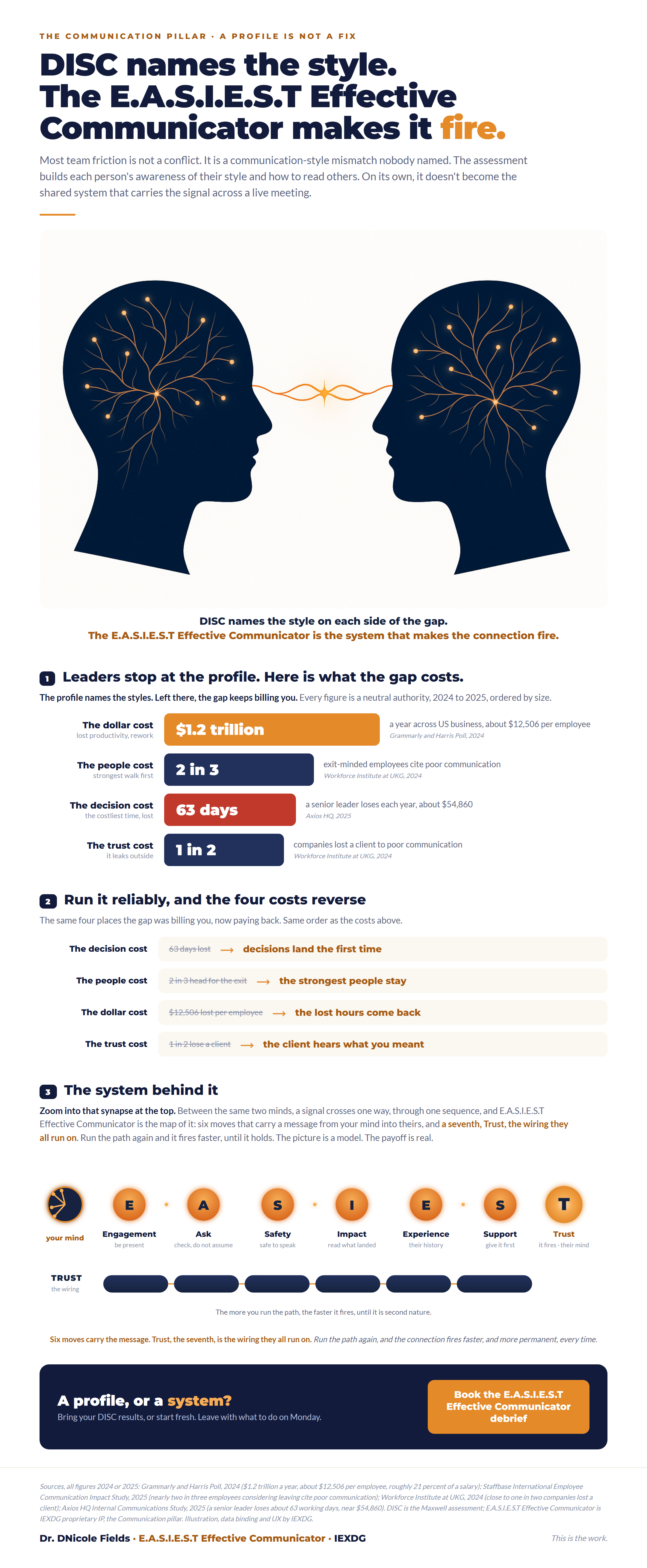
▶ Listen instead · 60 secondsEveryone took the assessment. The team still missed each other. DISC names how your people communicate, not what to do when two styles collide. Here is the gap.
The profile came back. One was a high D, one was a high S, and the room nodded like something had been solved. A month later the same meeting fell apart in the same place it always does, and the same two people walked out sure the other one was the problem. The assessment was not wrong about their styles. It was silent about what to do when they collide, because those are two different things, and the one that decides whether the work moves is the one the printout does not carry.
Sources: Grammarly and Harris Poll (2024); Staffbase International Employee Communication Impact Study (2025); Axios HQ Internal Communications Study (2025).
What you will walk away with
- Why a team can know their DISC letters and still miss each other every week
- The four places a communication-style mismatch quietly bills you, with current numbers
- The seven-part E.A.S.I.E.S.T move that turns a flat profile into what to do on Monday
1 · What the assessment actually measures
I use the Maxwell DISC Method. I like it. It is a good map of how a person is wired to communicate, and knowing the map is real progress over guessing. But a map is not a drive. DISC shows a person how they are wired to communicate, and how everyone else is wired too, including how to begin connecting across styles. What it does not do on its own is turn that awareness into a shared system a team runs in the live moment two styles collide, one feeling steamrolled and the other stalled.
So a team takes the assessment, learns their letters, feels understood for an afternoon, and then walks back into the same meeting and misses each other in the exact same place. The letters were the input. The work was supposed to start after.
▸The pattern: DISC names how a person communicates. The D, I, S, and C are genuine styles, and knowing yours and reading others' is real insight. What it isn't, on its own, is the system that carries a team through the moment two styles collide.
Her own words, from the field: "The assessment was never the answer. It was the map. The work is teaching a team to drive it."
The same mismatch, read in three sectors
2 · Four ways a style mismatch bills you, quietly
Nobody puts "we talk past each other" on a budget line. It still gets paid, in four places, and the numbers are current and neutral.
3 · Why it compounds upward
The number that stops me is not the average, it is the gradient. A senior leader earning over 200,000 dollars loses about 63 working days a year to ineffective communication, close to 54,860 dollars, because the people whose time is worth the most spend it untangling what was meant instead of deciding what is next.
▸The pattern: a style mismatch does not stay small, it scales with the seniority of the people caught in it, which is exactly the group the printout was supposed to help.
Axios HQ Internal Communications Study, 2025.

4 · DISC gives you the map. The E.A.S.I.E.S.T Effective Communicator is how a team learns to drive it.
This is the whole turn. A style assessment names how someone communicates. That is the map. What it doesn't do on its own is teach a team to drive it. The E.A.S.I.E.S.T Effective Communicator® framework is seven things a leader can do on Monday, in order:
Support figure: American Psychological Association, Work and Well-Being Survey, 2024.
▸The pattern: DISC hands a team four letters about themselves, E.A.S.I.E.S.T Effective Communicator hands them seven moves toward each other, and only the second one is the work.
A DISC printout next to an E.A.S.I.E.S.T debrief
Most teams stop at the assessment because it is familiar and it scales. This is a diagnostic, not a verdict. If you have only ever run the left column, the right column is worth an hour.
| Dimension | Maxwell DISC | E.A.S.I.E.S.T Effective Communicator® |
|---|---|---|
| What it builds | Self-awareness, a shared language, and general strategies to adapt across styles | A structured seven-move system for the live moment two styles collide |
| Who it centers | Each individual, understanding self and others | The whole team, running one shared practice |
| Where it works | The general foundation, before and around the hard conversation | Your team's specific breakdown, in the conversation it keeps having |
| What you leave with | Your styles, a common language, and adaptation tips | A read of which of the seven is breaking, and moves for the conversation you're dreading |
What to expect
- Bring your team's DISC results, or start fresh. Either works. If your team has not taken DISC yet, we can run it as part of the engagement so your first step is the assessment, and the debrief is what turns the letters into moves.
- The E.A.S.I.E.S.T Effective Communicator debrief. We read which of the seven is breaking on your team, live, with your real situations.
- Monday-morning moves, specific to the conversation you are dreading, not a generic tip sheet.
- A team-level pattern, the one place your styles keep colliding, named so you can watch for it.
- The path to the full diagnostic if the mismatch runs deeper than communication, into the six pillars.
Cost and return
The debrief is 30 minutes. The mismatch it reads is costing a single senior leader about 54,860 dollars a year in lost days alone, and that is before the turnover, the redone work, and the client who heard the wrong thing. The return is not soft. It is the difference between a team that keeps missing each other and one that does not.
Who is behind this
IEXDG is a leadership and organizational culture development ecosystem built on owned intellectual property and measurable, system-driven delivery. Dr. DNicole Fields, Ed.D., works across corporate, government, and education, and the ELCC 6-Pillar Framework is her proprietary model. Communication is the first pillar, and the E.A.S.I.E.S.T Effective Communicator® is the framework that reads and rebuilds it. The debrief is 30 minutes. No profile theater, no filing cabinet. It ends with what to do.
For media inquiries, or to cite IEXDG research in your work, contact [email protected].
Related
The Survey Was Green. The Floor Was Cold.
Engagement is not belonging. Why a green survey can still sit on a cold floor, the Connection pillar.
Coaching vs Culture Change: What to Buy When
Why a good program fades against a system, and how to match the tool to the depth the problem actually lives at.
The D.I.R.E.C.T Correlation Diagnostic™
When the mismatch runs deeper than communication, read all six pillars at once and see where stated and lived culture diverge.
The E.A.S.I.E.S.T Effective Communicator® debrief
Bring your team's DISC results, or start fresh. We read which of the seven is breaking, and you leave with what to do about it on Monday, not another profile to file. It is the fastest way to stop paying the four costs above.
Book the debriefQuestions leaders ask
What does DISC actually tell you, and what does it miss?
DISC shows how a person is wired to communicate by default, their dominant style. It is a map of tendencies. What it does not do is tell two different styles what to do when they collide in a hard conversation, so a team can know their letters and still miss each other every week. The profile is the input, not the fix.
What does poor communication actually cost a business?
Up to 1.2 trillion dollars a year in lost productivity and rework across US business, about 12,506 dollars per employee, roughly 21 percent of a salary (Grammarly and Harris Poll, 2024). It also drives turnover: nearly two in three employees considering leaving name poor internal communication as a reason (Staffbase International Employee Communication Impact Study, 2025).
Why do our meetings keep stalling even though everyone is capable?
Capable people in mismatched styles talk past each other. A person earning 50,000 to 100,000 dollars loses more than 35 working days a year, and a senior leader over 200,000 loses about 63 days, near 54,860 dollars (Axios HQ, 2025). The higher the role, the more expensive the mismatch.
What is the E.A.S.I.E.S.T Effective Communicator and how is it different from DISC?
The E.A.S.I.E.S.T Effective Communicator is the framework of seven things a leader can do: Engagement, Ask Questions, Safety, Impact, Experience, Support, Trust. DISC names how someone communicates; the E.A.S.I.E.S.T Effective Communicator names what to do about it, so a flat profile becomes Monday-morning moves. It is the Communication pillar in practice.
How do I tell if my team has a hidden communication-style problem?
Three quiet signs: the same meeting keeps ending the same way, a strong performer has gone quiet, and you spend part of your day untangling what people meant. About 75 percent of business leaders admit they overspend time fixing communication breakdowns (Grammarly and Harris Poll, 2024). The debrief reads which of the seven is breaking.
If your team keeps missing each other in the same place, it is not the assessment you bought or the effort they gave. It is a map with no moves. The E.A.S.I.E.S.T Effective Communicator debrief reads which of the seven is breaking, and the D.I.R.E.C.T Correlation Diagnostic reads all six pillars when the mismatch runs deeper. A diagnostic conversation, not a pitch.
Clarity Calls are available this week. 30 minutes. No pitch.