



Why does the climate report say the culture is fine when the building says otherwise?
For superintendents, principals and district leaders. Two true accounts of one school year, why the distance between them is the diagnosis, and the three structural fixes that close it. Written for education, built to travel to government and corporate.
▶ Listen instead · 57 secondsA superintendent opens the spring climate report and everything is compliant. A teacher two miles away has stopped raising her hand in the staff meeting because the last three times cost her something and changed nothing. Both of those are accurate accounts of the same school year.
This is not a story about a dishonest report or a disengaged teacher. It is a structural problem: the organization is running two cultures at once, each keeping its own records, and the only number that matters is the distance between them. Nobody on either side can see that distance, because nothing in the building is built to measure it.
- The structural reason two honest accounts of one year stop matching
- Why the distance is invisible in every survey a district already runs
- A diagnostic you can run on one team, this week, without buying anything
The two records, side by side
Every district keeps two sets of records. One is written down: board minutes, the strategic plan, compliance hours, the climate survey. The other is carried: who speaks in a meeting, who goes quiet, which policy everyone politely ignores. The first is auditable. The second is what people actually mean when they say the culture.

Below is one school year in both records, across the six pillars of the Effective Leadership Culture Code®. Read the left column first, the way a board reads it. Then read the right. Nothing in the right column contradicts the left. That is the problem.
Notice what did not happen. No line on the right calls a line on the left false. Common planning time really is on the master schedule. It really is the first thing cancelled. Both statements survive an audit, and the gap between them is where the year is actually lived.
▸The pattern: two accounts of one year stop matching long before either one becomes false. The record keeps what can be audited. The building keeps what was felt. Nothing has to be a lie for the distance to open.
Nobody in the chain is lying
The obvious explanation for two records is that somebody is shading the truth. Sit in a district for a week and that explanation stops being available. What is actually happening is quieter and harder to fix, and it happens twice. Almost nobody in a district talks to anyone more than one level above them, so what a teacher knows travels upward as a run of summaries, each one written by the person who is accountable for what it describes. That is the loss you can diagram. The second loss is the one that never enters the diagram, because the person at the bottom decided the cost of saying it was higher than the odds of anything changing.
Read the last two rows together. There is one teacher voice in that room, the team lead, and she is carrying an entire faculty's account into it. She also has a classroom of her own, the same evaluation cycle as everyone she is speaking for, and the same principal writing it. Whatever she judges is worth saying is what the building says about itself. Note who else is in there. The coaches support teachers, they do not evaluate them, so the people in that room who are best placed to help her have no authority, and the person who does have authority is the one writing her evaluation.
▸The pattern: at the top the loss is summarising, at the bottom the loss is backlash. RAND measured that loss across a single level, the principal down the hall against the district office across town, and found nineteen points. The loss at the bottom does not show up in any survey at all, because the person who would have reported it is the person deciding not to.
Why an honest leader files a compliant report
Here is the part that is hardest to say out loud, and it is the reason both records stay standing. The stated culture is never a neutral account. It is always somebody's account of their own work.
A principal reporting on her building is reporting on herself. The building's numbers carry her name, her evaluation, and the reputation she has spent years building downtown. For her to write down what her teachers are actually living, she has to write down that it is happening under her. Then she has to hand that upward to people who will read it as a problem with her rather than as a problem she had the nerve to name.
So she rounds it. Not because she is dishonest. She rounds it the way anyone rounds a thing that can be used against them later. Her area superintendent rounds it again before the district office sees it, because a cluster that keeps producing bad news becomes a cluster with a problem, and so does the person supervising it. District leaders round it once more. The superintendent rounds it once more before the board, because boards are elected and bad news in public session has a way of becoming a headline instead of a plan.
Every level is protecting itself from the level directly above it. Every level believes it is being reasonable, and every level is right. The teacher who stops raising her hand is doing the same arithmetic her principal is doing, and her principal's boss is doing, all the way up. She is just the only one who gets called disengaged for it.
▸The pattern: the same fear runs the whole height of the organization, and the bigger the district the more levels there are to run through. Nobody in that chain is a coward and nobody is lying. Each one is being careful in precisely the way the level above them taught, and the compliant report is what careful looks like when it reaches the top.
There is a second route, and everyone in the building already knows it
That chain is not the only way into a superintendent's office. It is only the one that runs through the staff. Anyone who has worked a school year can rank the routes by how fast they arrive, and the ranking is the same in almost every district.
Read the middle column again, because the order of it is the whole point. The teacher is one step from the leadership team, close enough to raise it with her own team lead in a corridor, and she waits five months. The parent has no place on the organizational chart at all and is answered before lunch. Distance is not what decides whether a voice carries in a district. Leverage is, and a teacher's leverage is the one thing nobody ever writes down.
She is not being cynical and she is not disengaged. She has worked out which inputs move this system, noticed that hers is not one of them, and stopped spending on it. Every organization teaches its people what is worth raising. Most of them teach it by accident.
The condition has a name, and your report is already measuring it
What that produces is not disengagement, and calling it disengagement is what sends districts after the wrong fix. It is fearful compliance. Staying under the radar. Doing what is visible, on time, to the standard, and volunteering nothing that could come back on you. It looks like professionalism from the district office, and from inside it feels like self protection, because that is what it is.
Now read the left column of that first table again. Ninety four percent received the strategic plan. Professional development hours fully compliant. Walkthroughs completed monthly. Mentoring in place for every new teacher. Every one of those is a measurement of compliance, and compliance is precisely what fear produces. The report is not failing to detect the problem. It is reporting the problem as a success, in the only vocabulary it has.
▸The pattern: compliance is what fear looks like on a spreadsheet. When the only voices that reach the district office without friction are the ones holding leverage over it, a climate report stops measuring the culture and starts measuring who still thinks it is worth the trouble.
The number nobody has
The obvious next question is how big the distance usually is. It is a fair question, and the honest answer is that the field cannot tell you.
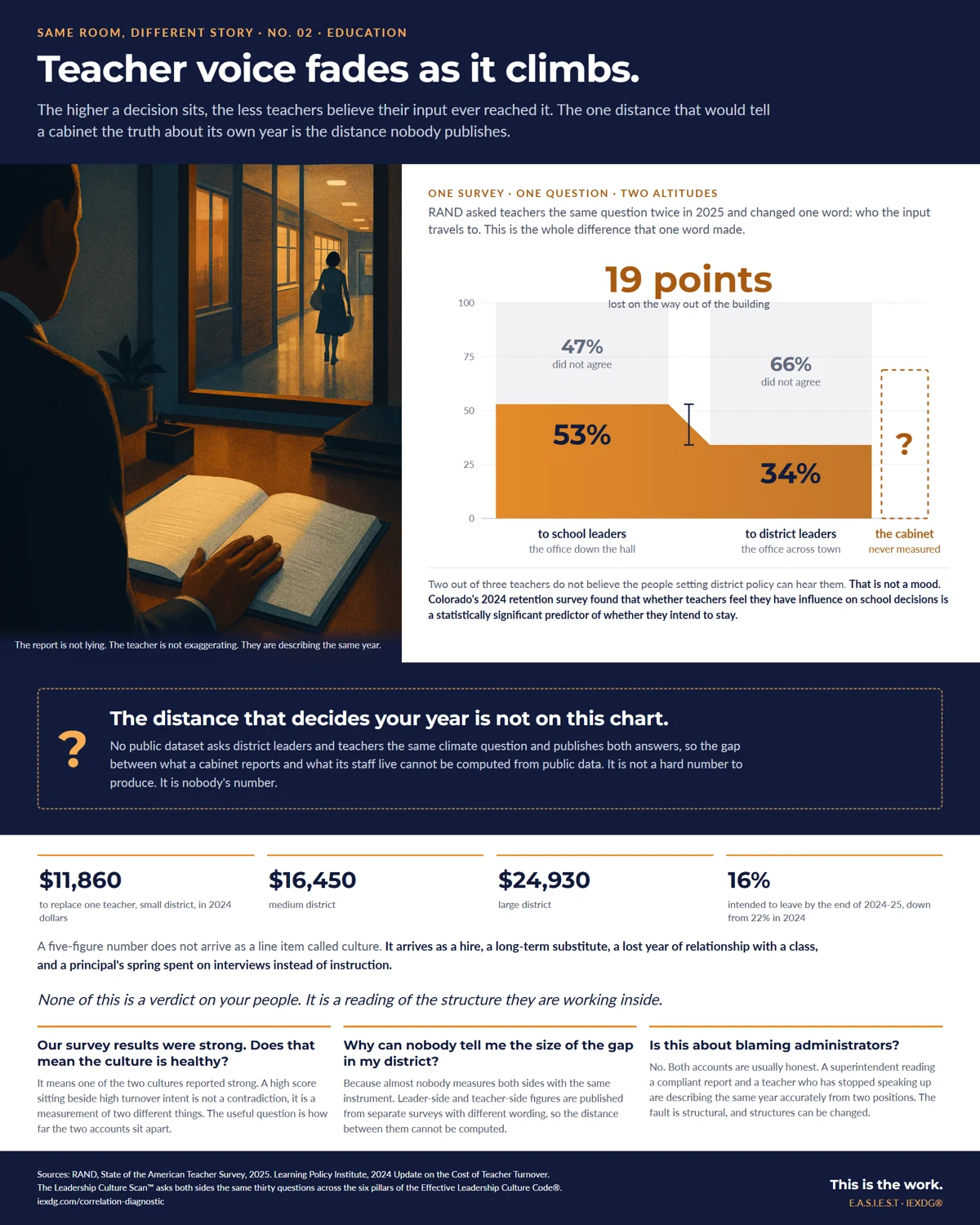
There is one distance the field can measure, and it is worth sitting with. RAND asked teachers the same question twice in 2025 and changed a single word: whether the input they give is valued and influences decisions, first at the school and then at the district. Fifty three percent agreed at the school level. Thirty four percent agreed at the district level. That is a nineteen point drop between the office down the hall and the office across town, on one instrument, in one year, from the same teachers. Put the other way: forty seven percent did not agree even about the principal they see every day, and sixty six percent did not agree about the people setting district policy.
That belief is not a mood, and it is not a soft measure. The Colorado Department of Education's 2024 Teacher Recruitment and Retention Survey found that whether teachers feel they have an adequate level of influence on school decisions is a statistically significant predictor of whether they intend to keep teaching. Voice and retention are the same conversation. RAND's own intent figure moved from twenty two percent in 2024 to sixteen percent in 2025, which is movement worth reading rather than a number worth celebrating.
What no public dataset will give you is the distance that actually decides your year. None asks district leaders and teachers the same climate question and publishes both answers, so the gap between what district leaders report and what the people in their classrooms live cannot be computed from public data. Leader-side and teacher-side figures come from separate surveys with different wording. It is not a hard number to produce. It is nobody's number.
This is the part that should land uncomfortably for anyone who has spent a decade running climate surveys. The instruments are fine. They are simply pointed at one side of the room. Ask district leaders how the culture is and you get the record. Ask the teacher who is with those students every hour of every day, and you get the building. Ask both the same thirty questions and the distance becomes a measurement, which means it becomes something district leaders can act on.
▸The pattern: the instrument decides what you are allowed to see. A survey aimed at one side of the room returns one side of the room, every time, and returns it with a confidence interval that makes it feel complete.
What each instrument can and cannot see
| The question | An engagement or climate survey | A leadership culture diagnosis |
|---|---|---|
| Who is asked | Usually certificated staff, in one direction | Every layer from the district office to the classroom, the same thirty questions |
| What it returns | A score, and a benchmark against other organizations | The distance between the two accounts, and the pillar carrying it |
| When results are withheld | Below a confidentiality threshold, too few respondents | Also when the evidence is thin, too few answers |
| What you do Monday | Read the dashboard, plan the next survey | Start three structural fixes inside seven days |
| What the board sees | A number that moved, or did not | A SWOT that names the risk nobody is funding |
What running this actually looks like
- Every layer answers the same instrument. Thirty questions across the six pillars. District leaders, principals, assistant principals, team leads and teachers, each answering separately, same wording. Not two sides. Every level between the board and the classroom. This is the step almost nobody takes, and it is the only one that makes a distance computable.
- The distance is read, not the score. Each pillar comes back aligned, undersold, or a blind spot, where leadership rates it high and the building lives it low. Blind spots are the dangerous ones, because nobody at the top believes there is anything to fund.
- The pillar carrying the strain gets named. One pillar, not six. If the evidence cannot carry a name, it does not get one, and that is reported plainly rather than smoothed.
- Three structural fixes, each startable inside seven days. Each one acts on a structure, never on a person, and each names how you will know it worked.
- A SWOT you can hand upward. Board-ready, every line carrying its evidence, so the first question from a trustee has an answer in the document.
What the distance costs
The cost of an unmeasured gap does not appear as a line item called culture. It appears as replacement.
The Learning Policy Institute puts the cost of replacing a single teacher at $11,860 small district, $16,450 medium, $24,930 large, per teacher, in 2024 dollars. In a district losing a dozen teachers a year it is not a soft number, it is a hire, a long-term substitute, a lost year of relationship with a class, and a principal's spring spent on interviews instead of instruction.
RAND's 2025 survey found 16 percent of teachers intended to leave by the end of the 2024-25 school year. An intention is not an exit, and that is exactly why it is useful. Intention is the signal that arrives a year early, in the register nobody is reading.
▸The pattern: the cost lands in a budget line that is never called culture. It is called replacement, coverage, recruitment. The distance is what produced it, and nothing in the ledger says so.
The Two-Culture Read
Six pillars. For each one, set two marks: what your reporting says, and what you believe your people actually experience. Answer as the room, not as the report. Nothing is sent anywhere and nothing is stored until you ask for the version you can take to your board.
This is not a score. It is one team's reading from one vantage point, and it points at structure rather than at people. The distance itself can only be computed when every layer answers the same thirty questions.
Want the version you can take to your board? We will send it. One field, and it is a delivery address, not a form.
Questions leaders ask
What is the difference between a climate survey and a culture diagnosis?
Our survey results were strong. Does that mean the culture is healthy?
Why can nobody tell me the size of the gap in my district?
Is this about blaming administrators?
How long does a Leadership Culture Scan take?
Does this work outside K-12?
The instrument is the Leadership Culture Scan™, thirty questions across the six pillars of the Effective Leadership Culture Code®. From signed agreement to a delivered SWOT and three structural fixes is five to seven business days. No discovery-phase theater. Scope is set on the Clarity Call and sized to the department, not quoted from a page.
IEXDG® does not use testimonial language or motivational framing in its published work. The results speak through diagnostic data.
Keep reading
Every Organization Runs Two Cultures
Where the series starts. Why both accounts are true, and why the distance is the diagnosis.
The Survey Was Green. The Floor Was Cold.
Engagement is not belonging. The same distance, read through the Connection pillar.
The Training Worked. The Culture Did Not Change.
Why compliant professional development leaves the building exactly as it found it.
If the two records in this Culture Insight sound like your district, that is not a reflection of your people's effort. It is the distance between two accounts that nobody has been asked to measure together. The D.I.R.E.C.T Correlation Diagnostic™ names where the distance sits, and a clarity call turns the name into three moves you can start inside a week.
Clarity Calls are available this week. 30 minutes. No pitch.
Sources. Learning Policy Institute, 2024 Update: What's the Cost of Teacher Turnover ($11,860 small district, $16,450 medium, $24,930 large, per teacher, in 2024 dollars). RAND, State of the American Teacher, 2025. Colorado Department of Education, Teacher Recruitment and Retention Survey, 2024.
None of this is a verdict on your people. It is a reading of the structure they are working inside. This is the work.