



The Survey Was Green. The Floor Was Cold.
For the leader reading a healthy dashboard. Engagement measures effort. Belonging measures whether your best people feel part of it. A survey can read green while the strongest quietly feel like outsiders, and quietly leave.
▶ Listen instead · 55 secondsThe survey was green. The floor was cold. Here is the gap.
The engagement numbers came back healthy, so you exhaled. Participation was high, the scores were up, the dashboard was green. Then a month later one of your strongest people gave notice, and in the exit conversation you heard a version of the same sentence you did not see coming: I never really felt part of it. The survey was not wrong about effort. It was silent about belonging, because those are two different things, and the one that decides who stays is the one the dashboard does not read.
Sources: The Conference Board, Job Satisfaction (2024 to 2025); US Bureau of Labor Statistics, JOLTS (2025); American Psychological Association, Work in America (2024). Every number on this page is 2024 or 2025 and verified against neutral authorities.
What you will walk away with
- Why a green engagement score is not proof of belonging, and not proof of retention
- What belonging actually is, why the best people feel its absence first, and what it costs
- A 60-second check to read the floor of your team, not just the survey
1 · What the survey actually measures
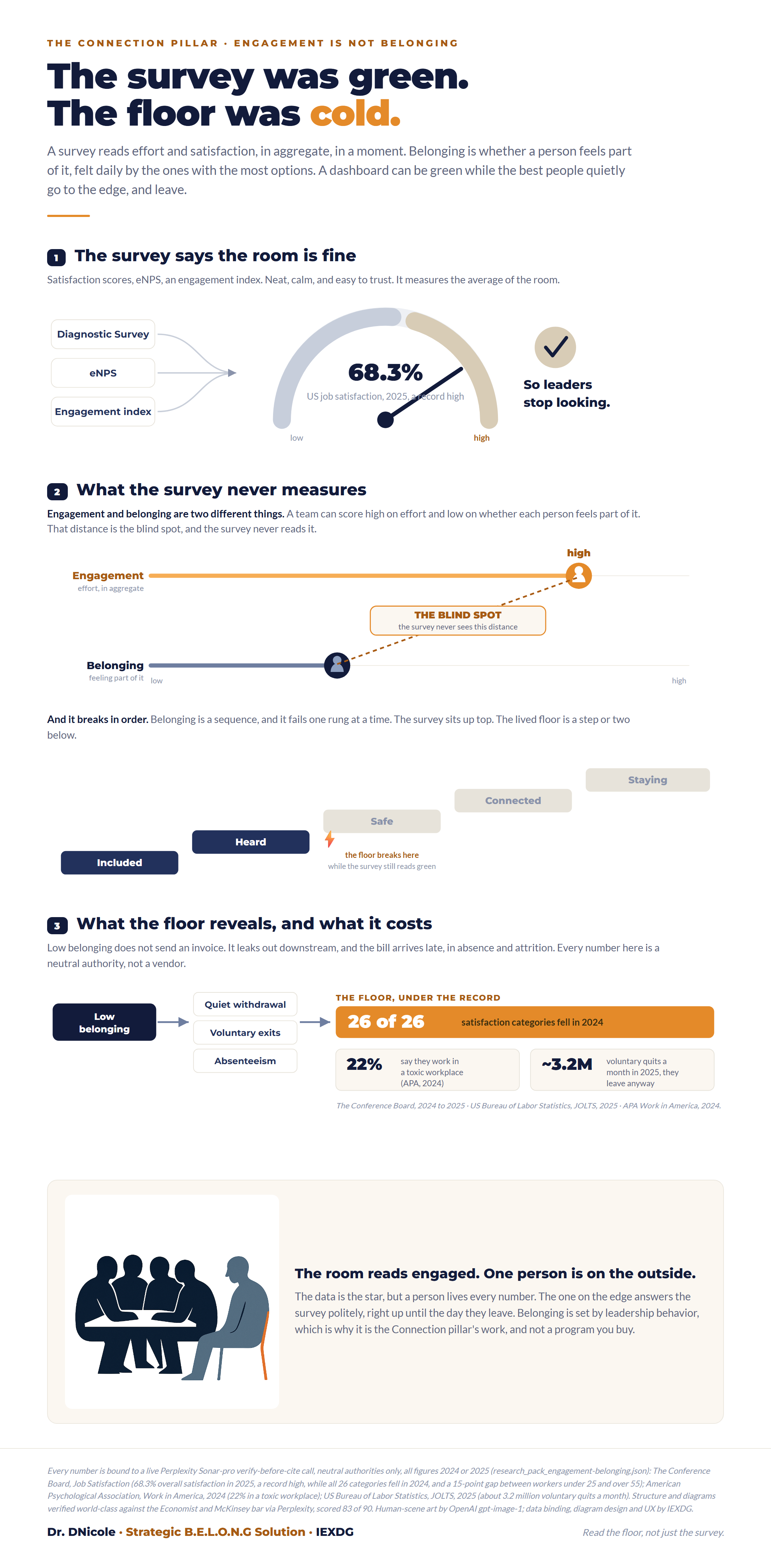
An engagement survey is good at one thing: it reads effort and satisfaction, in aggregate, in a moment. Are people trying, do they have what they need, would they recommend the place. Those are real and worth knowing. But they are not the same question as whether a given person feels they are truly part of the team, and a busy, polite, hard-working person can answer the survey warmly while quietly feeling on the outside. That is why the score can read green while belonging is already cold: the instrument was never pointed at belonging.
Belonging is a separate construct, and it behaves differently. It is felt daily, not in a survey window. It is felt most sharply by the people with the most options, the ones you least want to lose. And it does not fail loudly. It breaks one strong performer at a time, in silence, until a resignation makes it visible. The dashboard reads the room's effort. It does not read the one person on the edge of it.
▸The pattern: engagement measures effort in aggregate, belonging measures whether a person feels part of it, and a green score on the first tells you almost nothing about the second.
Her own words, from the field: "Your best people are not quiet quitting. They are culture-quitting."
The same gap, read in three sectors
2 · Why the best people feel the cold first
Belonging is not distributed evenly, and neither is the cost of its absence. The people who feel a cold floor first are the ones with the most options, because they are the ones who can act on it. They do not stage a protest. They do the work, answer the survey, and start taking the call. US voluntary quits ran about 3.2 million a month in 2025, even at a low quit rate, which means turnover was never simply a hot-market story. Some meaningful share of it is people who looked satisfied on paper and did not feel part of it in practice.
This is why a record score can be dangerous: it feels like permission to stop looking. In 2025 US job satisfaction reached a record high of 68.3 percent, and in the same window all 26 categories of job satisfaction underneath it fell (The Conference Board), while about 22 percent of workers say they are in a toxic workplace (APA, 2024). The floor being cold is expensive. It just does not send an invoice, and it does not show up on the dashboard.
▸The pattern: belonging is felt first by the people with the most options, engagement is not retention, and the cost of a cold floor is large and invisible to the survey.
3 · How to read the floor
You read the floor by asking the questions a survey averages away. Not how engaged is the team, but does each person on it feel part of it. Ask whether your strongest performers are in the room where their work gets decided, or hearing about it after. Ask whether someone could raise an uncomfortable truth this week and still be safe next week. Ask who has gone quiet, and whether you have read that quiet as agreement. Belonging is set by these day-to-day leadership behaviors, not by a policy or a program you buy, which is exactly why it is the Connection pillar's work and not a purchase.
▸The pattern: belonging is set by leadership behavior, so you read it by reading behavior, whose voice is in the room, who is safe to disagree, and who has quietly gone to the edge.

An engagement survey next to a belonging read
Most organizations choose the survey because it is familiar and it scales. This is a diagnostic, not a verdict. If you have only ever run the left column, the right column is worth examining.
| Dimension | Engagement survey | D.I.R.E.C.T Correlation Diagnostic™ |
|---|---|---|
| What it measures | Effort and satisfaction, in aggregate | Whether each person feels part of it, the lived floor |
| Who it hears | The average of the room | The person on the edge of it, before they leave |
| Predicts retention? | Weakly, engagement is not retention | Directly, belonging is what decides who stays |
| What you get | A score to watch | A SWOT and three structural fixes |
What to expect
- Clarity Call. 30 minutes, no fee, a diagnostic frame, not a pitch.
- The Correlation Diagnostic intake. A 5 to 7 day window that reads where the stated culture and the lived culture diverge.
- SWOT and three structural fixes, delivered as a brief you can act on, not a dashboard you watch forever.
- Implementation cadence, weekly or bi-weekly, so the fixes live in the system, not in a binder.
- Outcome measurement at 90 days, board-reportable, so the floor and the survey finally agree.
Cost and return
The cost of a cold floor is paid in absence and attrition, not in a line item, which is why it is so easy to leave unaddressed behind a record score. In 2025 US job satisfaction hit a record high of 68.3 percent, yet all 26 categories of satisfaction fell in 2024 (The Conference Board), and satisfaction ran 72.4 percent for workers over 55 against only 57.4 percent for those under 25, a 15-point gap the average erases. About 22 percent of workers say they are in a toxic workplace (APA, 2024), and voluntary quits ran near 3.2 million a month in 2025 (US Bureau of Labor Statistics, JOLTS). The return on reading belonging is the absence you stop paying for and the strong performer you keep.
Sources: The Conference Board, Job Satisfaction (2024 to 2025); American Psychological Association, Work in America (2024); US Bureau of Labor Statistics, JOLTS (2025). All figures 2024 or 2025, verified against neutral authorities.
Who is behind this
IEXDG is a leadership and organizational culture development ecosystem built on owned intellectual property and measurable, system-driven delivery. Dr. DNicole Fields, Ed.D., works across corporate, government, and education, and the ELCC 6-Pillar Framework is her proprietary model. Belonging is the Connection pillar, and the Strategic B.E.L.O.N.G Solution is the program that reads and rebuilds it. From signed agreement to SWOT delivery is 5 to 7 business days. No discovery-phase theater. Engagement scope is set on the Clarity Call and sized to the department, not quoted from a page.
IEXDG does not use testimonial language or motivational framing in its published work. The results speak through diagnostic data, not endorsements.
Related
Everyone Took the Assessment. The Team Still Missed Each Other.
DISC names how your people communicate. The E.A.S.I.E.S.T Effective Communicator is the system a team runs when two styles collide.
Coaching vs Culture Change: What to Buy When
Why a good program fades against a system, and how to match the tool to the depth the problem actually lives at.
The D.I.R.E.C.T Correlation Diagnostic™
When the gap runs deeper than one pillar, read all six at once and see where your stated and lived culture diverge.
Questions leaders ask
What is the difference between engagement and belonging?
Engagement measures effort and satisfaction, how hard people are trying and whether they would recommend the place. Belonging measures whether a person feels they are truly part of it. They are different constructs. A team can look engaged on a survey while the people with the most options quietly feel like outsiders, so a green engagement score is not proof of belonging and it is not proof of retention.
Why do my best people leave when the engagement survey looks fine?
Because engagement is not retention. US voluntary quits ran about 3.2 million a month in 2025, even at a low quit rate (US Bureau of Labor Statistics, JOLTS), and the strongest performers leave first because they have the most options. A survey answered politely in a moment does not capture whether someone feels part of the team, which is what actually decides whether they stay.
What does workplace loneliness and disconnection actually cost?
In 2025 US job satisfaction hit a record high of 68.3 percent, yet across all 26 categories of job satisfaction workers reported declines in 2024 (The Conference Board), and about 22 percent of workers say they are in a toxic workplace (APA, 2024). The cost of a cold floor is real and largely invisible to a headline satisfaction score.
Can you measure belonging with an engagement survey?
Not on its own. An engagement survey reads effort and satisfaction in aggregate, in a moment. Belonging is felt daily and breaks quietly, one strong performer at a time, so it can be gone while the aggregate score still reads green. You have to read the floor, the lived experience, not just the survey.
Is belonging a DEIB program you buy?
No. Belonging is set by day-to-day leadership behavior, not by a policy or a program you purchase. That is why it is the Connection pillar's work in the ELCC framework: it lives in how leaders show up, who is heard, and whether the relational infrastructure is trusted, which no single program can install.
How do I tell if my green survey is hiding a belonging problem?
The D.I.R.E.C.T Correlation Diagnostic reads where your stated culture and your lived culture diverge, including whether your strongest people feel part of it or on the outside, and returns a SWOT with three structural fixes. It answers the question the dashboard cannot: is the floor as green as the survey?
Read the floor, not just the survey
A green dashboard can still sit on a cold floor. The D.I.R.E.C.T Correlation Diagnostic reads where your stated culture and your lived culture diverge, including who feels part of it and who is quietly on the outside. A diagnostic conversation, not another survey to file.
Take the Correlation DiagnosticIf this sounds familiar, it is not a reflection of your team's effort or your survey. It is the gap between a green dashboard and a cold floor. The D.I.R.E.C.T Correlation Diagnostic is built to read exactly where your stated culture and your lived culture diverge, including who feels part of it and who is on the outside. No report you watch forever. A diagnostic conversation.
Clarity Calls are available this week. 30 minutes. No pitch.