



They Are Not Quitting the Job.
They Are Quitting the Culture.
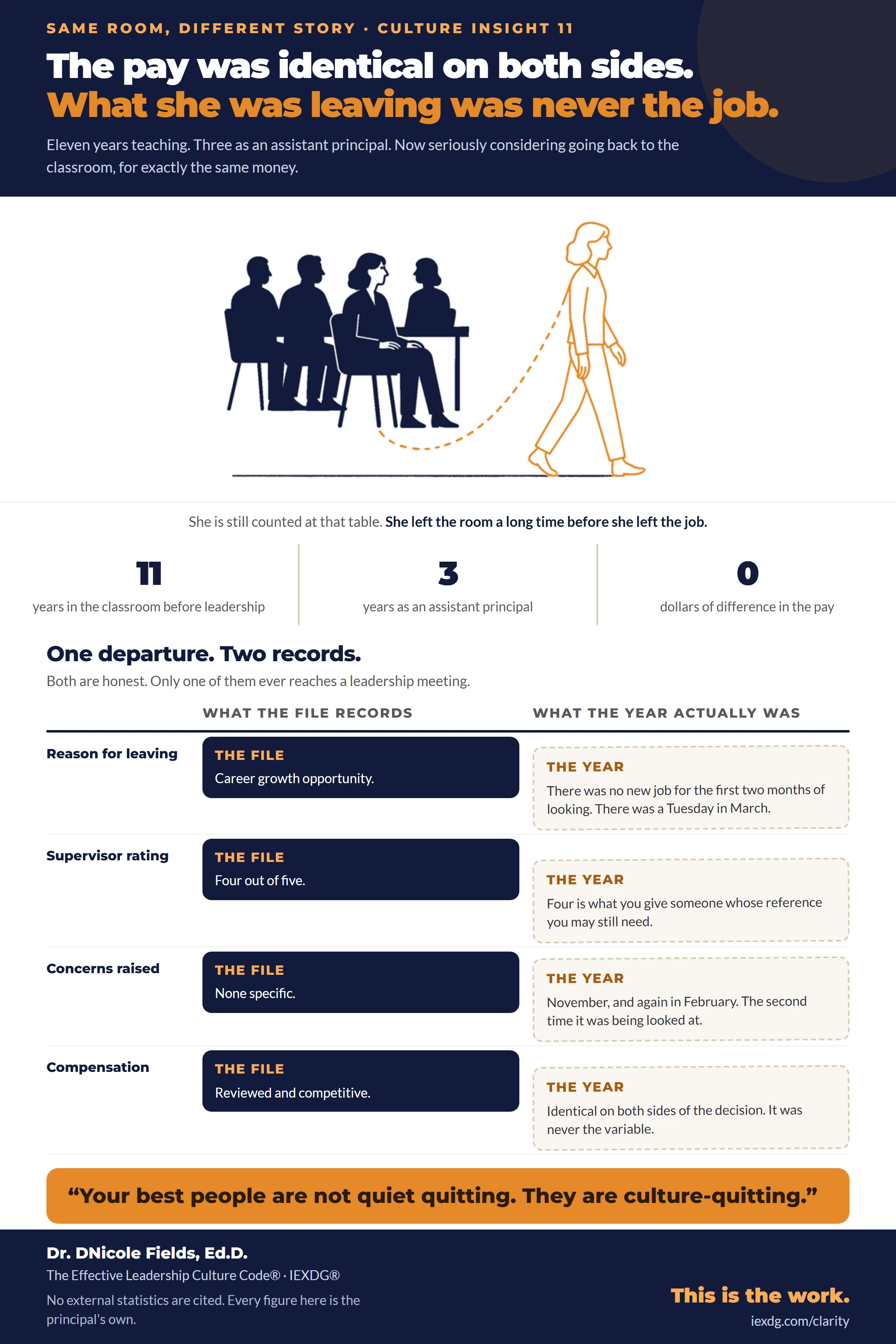
When a strong leader walks, the exit interview says career growth. The truth is usually quieter, and closer to home. They did not leave the mission. They left the room.
A principal wrote it out plainly, in a room of two hundred and thirty five thousand other school leaders.
Eleven years teaching. Three years as an assistant principal. And now, seriously considering going back to the classroom.
For the same pay.
Read that last part again, because it is the whole diagnosis. Not a pay cut they were willing to absorb to get out. The same money, to do a job with less authority and less title, because everything around the work had become more expensive than the work itself.
What you will walk away with
- Why the same-pay detail is the diagnosis, and not a footnote to it
- The order withdrawal actually happens in, and why your turnover report sees it last
- Why the people with the most options leave first, and what that costs you specifically
- The one question to ask your strongest person this week, and what to listen for in the answer
1 · The math they are doing
When somebody tells you they are thinking about stepping back into a role they already outgrew, and the pay is the same, they have finished a calculation you were never shown.
On one side, the title, the influence, the reason they went into leadership in the first place. On the other, everything the role costs them that has nothing to do with the role. The meetings where the decision was already made. The concern raised three times that went nowhere. The distance between what leadership says the culture is and what the building experiences on a Tuesday.
They did not decide the work was not worth it. They decided the conditions around the work were not worth it, and those are different findings that require different responses. One is a job design problem. The other is a leadership culture problem, and no compensation adjustment has ever solved it.
▸The pattern: when the pay is identical on both sides of the decision, you are not looking at a retention problem you can price. You are looking at what it costs to stay.

2 · What culture-quitting looks like
It is not a resignation. It is a withdrawal, and it happens in a reliable order.
Discretionary effort goes first, and it goes quietly. The extra read on the plan before the meeting. The hallway conversation that used to catch a problem early. Nobody files a report about it and nothing in your dashboard moves.
Presence goes second. They are in the room and they are professional and they are no longer bringing you the thing they noticed. That is the stage most leaders mistake for stability, because output has not dropped yet.
The name comes off the roster last. By the time it reaches your turnover report, the decision is often eighteen months old, which is why the exit interview feels so strangely calm. You are not watching someone decide. You are watching the paperwork catch up to a decision made a long time ago.
| Quiet quitting | Culture-quitting | |
|---|---|---|
| Who does it | Often your disengaged population | Often your strongest performers |
| What it signals | Workload, role clarity, boundaries | Belonging, voice, whether staying is worth it |
| Where you see it | Output and hours | Exit interviews you cannot decode |
| What moves it | Role design and expectations | Repair at the pillar that set the price |
The two look similar from the top of the building and call for opposite responses, which is why treating one as the other is expensive in both directions.
3 · Why it starts at the top
The people with the most options leave first. That is what makes this expensive, and it is the part that surprises leaders most.
You do not lose a random sample of your organization. You lose the people who can afford to go, which is the same group as the people you were most counting on. They are the ones with the network, the credential, the track record that means somebody else will take their call.
And they are also, usually, the ones who tried. Culture-quitting is very often what happens on the far side of somebody raising a concern more than once. The withdrawal is not indifference. It is the conclusion drawn after the attempt.
What walks out is not just a role to backfill. It is the eleven years of context, the relationships nobody documented, and the two years it takes before a replacement knows the building well enough to be trusted with the hard conversations. You do not feel that in the budget. You feel it in the meetings.
4 · Why the exit interview will not tell you
By the time you are running an exit interview, you are asking someone to be candid at the exact moment they have the least reason to be.
They need the reference. They may work with these people again in a field smaller than anyone admits. And the honest answer is not a single incident they can hand you, it is a pattern built over eighteen months that would take an hour to explain and would sound, said out loud, like a complaint.
So they say career growth. It is true enough to be defensible and vague enough to be safe, and it sends your correction to the wrong meeting entirely. You go looking at your promotion ladder when the finding was about the room.
Both of these are honest
That is the part worth sitting with. Nobody in this exchange lied. The left column is what the organization wrote down, and it is accurate. The right column is what the year actually was, and it is also accurate. They are two true accounts of the same departure, and only one of them ever reaches a leadership meeting.
The columns do not line up on purpose. They never do in the buildings either.
5 · Which of the six is doing it
Retention is not a staffing problem you solve with a hiring bonus. It is a structural read.
Communication, Connection, Collaboration, Captaincy, Culture and Competence either hold your people or hand them the door, and in almost every building I have read, it is not all six. It is one or two, doing most of the damage, in a way that is completely legible once you look at it directly and nearly invisible from an engagement score.
The Effective Leadership Culture Code® reads which one is doing which. Not who is disengaged, which puts the problem inside people where it is not, but where the message bends and which seat absorbs it.
Structures are fixable. Character judgments are not, which is one reason I refuse to make them.
6 · The question to ask this week
Who is behind this
Twenty nine years across education, government, associations and corporate. A doctorate in Educational Leadership. Six credentials that should have protected me from broken workplaces.
They did not. I wore a heart monitor at work, not because I was sick, but because the leadership culture around me was making me sick, and I want to be precise about that because it is the reason this methodology exists at all.
So I built the thing I needed when I was the one being broken. Now we install it inside the institutions doing the breaking.
Related
Every Organization Runs Two Cultures
Why two honest accounts of the same year stop matching.
Eight Seconds
What the silence after "any concerns" is actually measuring.
The Survey Was Green. The Floor Was Cold.
What an instrument records, and what it cannot reach.
There is nothing here to download
There is no assessment to score yourself against and no number to take away and read without me. The read is the engagement. If you want to know which pillar is handing your people the door in your building, that is a conversation rather than a document.
The Leadership Culture Intelligence Session™Questions leaders ask
Is culture-quitting just quiet quitting with a new name?
No, and the difference matters because the two call for opposite responses. Quiet quitting usually shows up in your disengaged population and it shows up as reduced output. Culture-quitting shows up in your strongest people and it shows up as departure. One is a signal about workload and role clarity. The other is a signal about whether staying is still worth what it costs.
How is this different from burnout?
Burnout is about depletion, and rest is part of its answer. Culture-quitting is about arithmetic. The person is not necessarily exhausted. They have simply concluded that the conditions are not going to change, and that conclusion is usually based on watching what happened the last several times somebody raised it.
We ran an engagement survey and it came back fine. Why did we still lose them?
Because a survey measures how people scored, not what they decided not to say. The people furthest along in culture-quitting are frequently the most careful respondents you have. They have already stopped spending effort on the channel, and a neutral score is cheaper than an honest one.
What does the Session measure that a survey does not?
Where the message bends, and which seat absorbs it. A survey gives you a distribution. The read gives you the structure underneath it, which of the six pillars is holding and which one is quietly handing people the door.
How long before we see movement?
The read itself runs 5 to 7 business days and ends with a six-pillar SWOT and the specific changes to make first. Movement on the underlying condition depends on which pillar is involved, and I would rather tell you that after reading your building than before.
Can you send me something to work through first?
There is nothing to send that would be worth your time. Anything I could hand you would give you a number without the read, and the read is the part that matters.
Twenty minutes, leader to leader. Bring the one thing your data is saying that your people are not.