



Eight Seconds
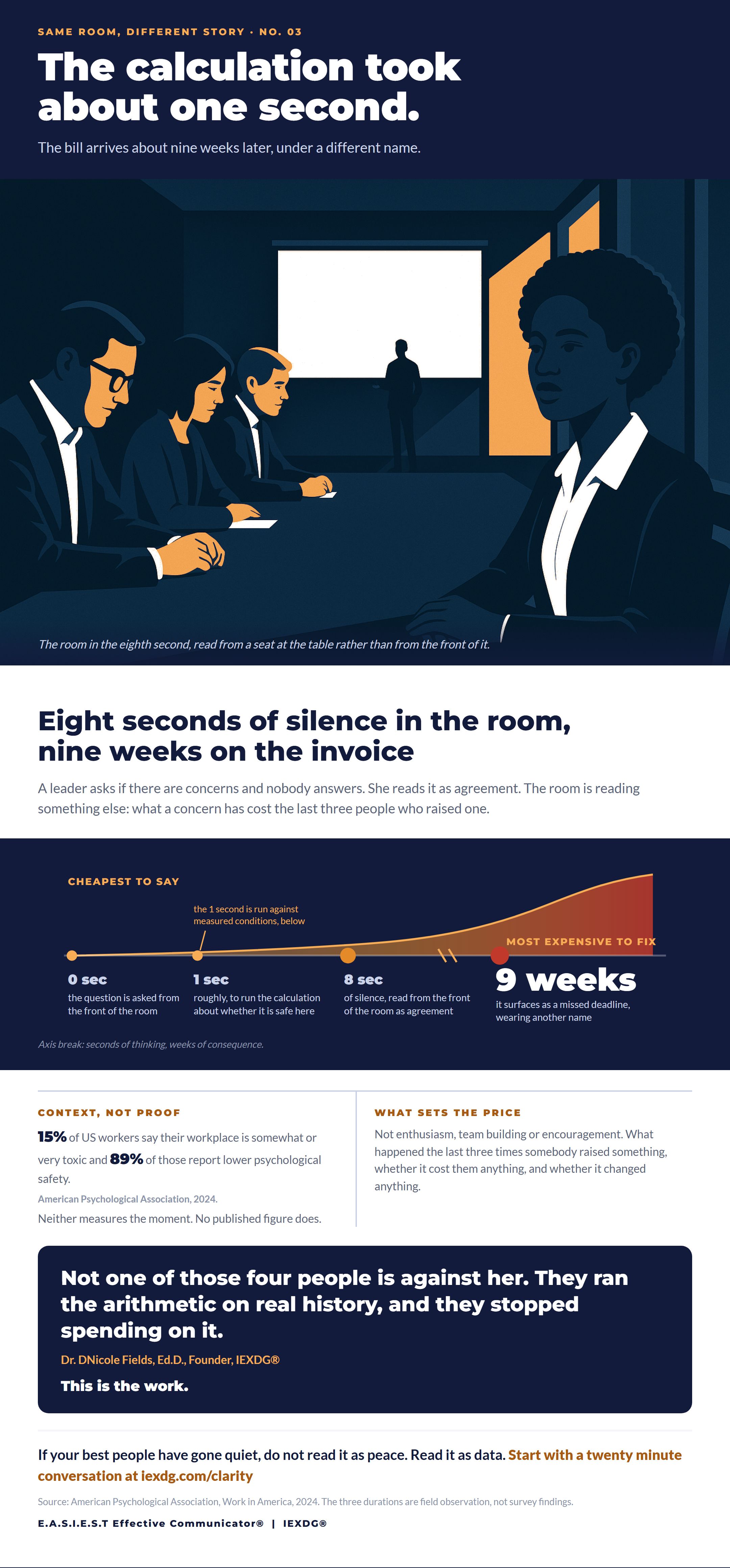
She asked if there were any concerns before moving forward, and got eight seconds of silence. She read it as alignment. Four people in that room were answering a different question, and they answered it correctly.
▶ Listen instead · 55 secondsShe ended the meeting the way she always ends the meeting.
"Any concerns before we move forward?"
Eight seconds of silence. She read it as alignment. Four people in that room read it as the eighth consecutive time it has not been worth answering that question honestly in front of everyone else who is also deciding whether to answer it honestly.
I want to slow down on those eight seconds, because I have watched a version of them in almost every building I have ever worked in, and I have never once seen them discussed afterward.
What you will walk away with
- What eight seconds of silence is actually measuring, and why it is not agreement
- Why the calculation your team runs before speaking is usually correct
- Where the cost lands, weeks later, under somebody else's name
- The one question most leaders cannot answer quickly, and what that says about the structure rather than the people
1 · Nobody in that room lied
This is the part leaders have the hardest time with, so I want to say it plainly.
She asked an open question and she got a truthful answer. The answer was truthful to the question the room actually heard, which was not "do you have concerns." It was "does anyone want to be the person who says so right now, in front of everyone, with the plan already written."
Those are different questions. People answer the second one. They answer it fast, and they answer it correctly.
2 · What the silence is measuring
The silence is not measuring agreement. It is measuring cost.
Every person on a team runs a calculation before they speak. Is it safe to say this here. It takes about a second, it happens before anyone is consciously aware of it, and the output is not honesty or dishonesty. The output is a risk assessment about the room.
And here is the thing that gets missed: the calculation is usually correct. Not one of those four people is against her. They ran the arithmetic on real history. The last three times somebody raised something in that room, it cost them something and changed nothing, so they stopped spending on it.
That is not a morale problem. It is not an attitude problem. It is a completely rational response to observed conditions, which is exactly why more enthusiasm, more team building, and more encouragement to speak up will not touch it.
▸The pattern: a room that has learned what a concern costs will keep paying the cheaper price, and it will keep being right to do so until the structure that set the price changes.
3 · What it actually costs
Two people left that meeting understanding the plan and expecting it to fail.
One of them had the specific reason. A dependency, a resource, a history with a vendor, something concrete that would have taken ninety seconds to say.
Nine weeks from now that reason surfaces. It will not surface as a concern raised in a meeting. It will surface as a missed deadline, a stalled rollout, or a project that quietly needed a second phase nobody budgeted.
And somebody will call that an execution problem. They will be looking at the wrong meeting.
That is the compounding cost of unspoken information, and it does not appear on any dashboard, because the moment it was cheapest to catch was the moment nobody was measuring.

What one unsaid concern costs, using only your numbers
Move these to your own building. There is no national multiplier in here, because no neutral published figure exists for the share of people who withhold a concern, which is the point the piece makes. Everything below is arithmetic on your own payroll. Nothing here is a quote for services. It is the bill you are already paying, written down.
4 · Why your survey did not catch this
Because a survey asks people to score a condition. It does not ask what they decided not to say, or where, or in front of whom.
You can have engagement scores trending up in the same quarter that three senior people quietly update their resumes. Those two facts are not in conflict. They are measuring different things. The score measures what people are willing to report. The resume measures what they have concluded.
▸The pattern: an instrument that asks people to rate a condition cannot see the decision they made not to raise one, so the reading comes back clean from a room that has gone quiet.
What most leaders look for, and what actually sets the price
| The question | The usual read | What the eight seconds is telling you |
|---|---|---|
| Who is the problem | The quiet ones. Disengaged, not bought in, needs coaching. | Nobody. Four people ran a correct calculation on real history. |
| What the silence means | Agreement, or at worst indifference. | A price. What a concern has cost the last three people who raised one. |
| Where the fix goes | Into the people. Enthusiasm, team building, encouragement to speak up. | Into the structure that set the price, which is the only thing the arithmetic answers to. |
| When it shows up | Nine weeks later, as a missed deadline, and it gets called execution. | In the eighth second, in the room, where it was cheapest to catch. |
5 · What I would actually look for
Not who is disengaged. That framing puts the problem inside people, and it is not there.
I look for where the message bends. Which seat absorbs it. Which problems reliably never reach the top desk, and what those problems have in common.
Because there is almost always a pattern. It is not random which concerns die and which ones travel. Something about the first category makes it expensive to carry, and once you can name that something, you are looking at a structure rather than at a list of individuals who need to be more forthcoming.
Structures are fixable. Character judgments are not, which is one reason I refuse to make them.
6 · The question I would leave you with
Who is behind this
Twenty nine years across education, government, associations and corporate. A doctorate in Educational Leadership. Six credentials that should have protected me from broken workplaces.
They did not. I wore a heart monitor at work, not because I was sick, but because the leadership culture around me was making me sick, and I want to be precise about that because it is the reason this methodology exists at all.
So I built the thing I needed when I was the one being broken. Now we install it inside the institutions doing the breaking.
Related
Why Does the Climate Report Say the Culture Is Fine
The same silence, read from a district office instead of a conference room.
The Survey Was Green. The Floor Was Cold.
What an instrument records, and what it cannot reach.
Every Organization Runs Two Cultures
Why two honest accounts of the same year stop matching.
There is nothing here to download
Nothing to work through on your own, and no number to take away and interpret without me. The read is the engagement. If you want to know what would surface in your building, that is a conversation rather than a document.
The Leadership Culture Intelligence Session™Questions leaders ask
What does silence in a meeting actually mean?
It is not a measure of agreement. It is a measure of cost. Before anyone speaks they run a fast, mostly unconscious read on whether it is safe to say this, here, in front of these people. When the recent history of that room says a concern costs something and changes nothing, silence is the rational answer.
We already ran an engagement survey. Does that not cover it?
Then you have the surface. A survey tells you how people scored. It does not tell you what they decided not to say, or where, or in front of whom. Different instrument, different question.
Is this a morale problem or an attitude problem?
Neither. The people staying quiet are usually not opposed to the decision and are usually not disengaged. They ran the arithmetic on real history in that room and reached a correct conclusion, which is exactly why more encouragement to speak up does not move it.
What does unspoken information cost?
It compounds, and it surfaces late and under the wrong name. The concern that would have taken ninety seconds to raise reappears weeks later as a missed deadline, a stalled rollout, or a second phase nobody budgeted. It then gets called an execution problem, which sends the correction to the wrong meeting.
Can I see a sample report?
It is built off your own organization, so a generic one would not tell you much about your situation. What I can do is walk you through what shows up in it and in what order. Ten minutes.
Can you send me something to work through first?
There is nothing to send that would be worth your time. Anything I could hand you would give you a number without the read, and the read is the part that matters. The read is the engagement, and it runs five days.
Twenty minutes, leader to leader. Bring the one thing your data is saying that your people are not.