



Why does a culture refuse to move until someone names it?
For the leader who has approved the programs and read the reports, and still cannot say plainly what is wrong. This post walks through one Wednesday meeting told two ways, and what changes when the person who speaks up is heard.
▶ Listen instead · 51 secondsIn an episode of The Neighborhood, Calvin’s employees keep quitting his shop, and he cannot work out why. His neighbor Dave, a professional conflict mediator, offers to find out.
The way I read that episode, the answer was behind the counter the whole time. Nobody in that shop is a villain. Calvin is simply the one person who cannot see it, because the shop was built around him.
Most organizations are running some version of that episode right now. The gap between the culture leaders describe and the culture people live is real, it is costing the organization money and people, and nobody with the standing to act on it has named it yet. This last post in the series is about the moment someone names it, and what changes after.
- How the people who see the gap end up telling everyone except the one person who could close it
- How your team hears your Wednesday meeting, and why what they really think rarely gets back to you
- Try this: write down how your last meeting sounded to your team, and ask one of them if you got it right
Why she wore a heart monitor to work
I wore a heart monitor at work, not because I was sick, but because the leadership culture around me was making me sick.
In education, pay moves when you earn another degree, so getting ahead usually means going back to school. I kept earning them, all the way to a doctorate in leadership. I had every credential to climb that ladder, and I chose not to, because I was not going to fix from the inside what was built to stay broken.
Many of your strongest people are making that same choice right now.
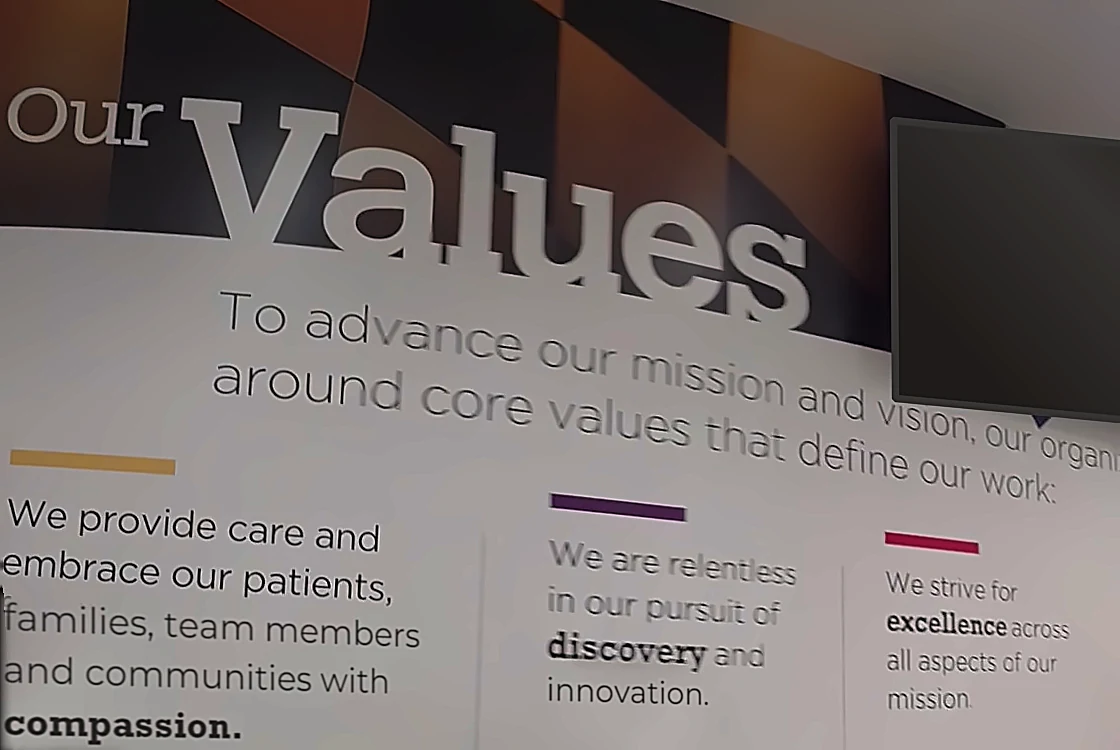
Values like these are usually sincere. Nobody writes them to deceive anyone. The leaders who approve them walk past them every day and hear almost nothing that contradicts them, because the people living the other culture have stopped saying it to them. The hallway hears it first. Two colleagues compare notes outside a meeting, a few steps from the office where the culture gets described, and the strongest of them starts answering recruiters.

Dr. DNicole Fields puts it plainly: “Every organization has two cultures. The one in the handbook, and the one in the hallway. The hallway always wins.”
▸The pattern: the leader who wrote the values is the last person anyone tells about a gap, a blind spot, or a missing piece. Nobody is hiding it on purpose. Everyone has seen what happens to the person who points one out, so it usually takes someone from outside to say it.
The same meeting can catch the gap or bury it
Senior leaders are rarely in the meetings where someone on their team disagrees, and by the time word reaches them, it has been smoothed into “the meeting went fine.”
A plan comes into the meeting already decided. Someone points out a gap in it and offers a fix. The manager running the meeting cuts them off, and the room goes still. Afterward, the people who watched say some version of the same thing: I’m just gonna keep my mouth shut.
How many of you have seen this play out before?
Same room. Different story.
Nobody in that room is lying. The managers heard silence and wrote down agreement. The team heard a warning and kept their concerns to themselves.
Naming the gap means saying what everyone in that room already knows. Nobody disagrees with a plan anymore, because the last person who did was shut down in front of everyone. On a high-performing team, that courageous conversation goes differently. Someone names the gap, the team fixes it, and the person who named it gets the credit.
▸The senior leader usually hears only the managers’ account of that meeting. The team’s account gets told everywhere else, and reaches the leader last, when someone resigns.
The same gap shows up in government, business, and schools
The same gap shows up in public records anyone can check: federal workforce data, the annual reports public companies file, and a school district report card. In each one the gap is on the record, and nobody with the power to act on it has named it.
Government. In 2024 federal workforce data from OPM, employees in thirty four federal agencies rated their own immediate supervisor at least fifteen points higher than they rated their senior leaders. Same employees, same questions, same year. In six agencies the two ratings match, which shows the gap is not built into government work. It sits in one layer of leadership, and that layer can be named.
Corporate. Of fifteen public companies we read, six tell their investors, in the annual report the law requires them to file, that their culture or their people are a competitive advantage, and show no measure of it anywhere in that report.
Education. A district report card can close the gap it was built to display and still say nothing about the one it was not built to show. The staff meeting where a teacher has stopped raising her hand does not appear on it, and No. 02 of this series walked through exactly why.
▸The gap can sit in public numbers for years. The federal data showed the supervisor gap and the annual reports printed the culture claims. What is still missing is one person with the authority to fix it saying so in a meeting.
Why the person who sees the gap leaves without raising it
Ask the people closest to the work what is wrong and most of them can tell you in under a minute. Nobody asks them in the Wednesday meeting, and they remember what happened to the last teammate who pointed out a flaw there. The managers shut it down in front of everyone.
The national numbers show the same lesson. In SHRM’s 2024 Civility Index, 3 in 10 workers reported incivility to HR or a manager, and 62 percent said their manager had ignored it.
So people stop raising it. The team loses the person who sees what is missing, the one who could have made the plan better before it moved forward. Dr. DNicole Fields hears it from them in plain words: “We just come and do the bare minimum we have to do.” Then the strongest of them leave, and the exit interview says career growth.
▸What people will not say in the Wednesday meeting, they eventually say with a resignation letter. By then the exit interview records a polite reason, and the real one leaves with the person.
What your engagement score tells you, and what a Leadership Culture Intelligence Session™ tells you
| What you need to know | Your engagement survey score | A Leadership Culture Intelligence Session™ |
|---|---|---|
| Is something wrong? | How people answered, usually once a year | Where it is wrong, and which problems never reach you |
| Why is it happening? | The score moved, or it did not | Where messages bend between you and the people doing the work |
| What do we do first? | You decide, on your own | Three structural fixes your team can put in place within seven days |
| Who walks you through it? | A report that lands in your inbox | A 45-minute debrief, live, and the fix scoped with you |
| How does the fix hold? | You wait for next year’s results | A roadmap for keeping it in place |
Keep your engagement survey to watch the trend. A Leadership Culture Intelligence Session™ shows you what is behind it. It starts with a Clarity Call.
What changes when the person who speaks up is heard
The person who speaks up in a meeting like that one is rarely calling anything a problem. As Dr. DNicole puts it, “They’re just talking about a gap that they see. Even bringing a solution that they’re just not willing to hear.”
Many of the same leaders will say their door is open. She has sat in those rooms. A plan arrives finished: “They just put it out there, and you’re supposed to just go with it.” When someone points out a gap anyway, it lands as “tearing down what they’re saying. Not that you’re catching a gap that can help everyone.”
Everyone else in the room watches what happens next. When the person who spoke up pays for it, the lesson spreads: “I don’t want that to happen to me. So I’m just gonna keep my mouth shut.” The room goes silent, “because everybody knows that was a risk they took.”
From the top, that silence can look like buy-in. She describes people who are “saying they received what you’re saying, but they really don’t.” The work still gets done, around the gap instead of through it, and “now you’re working harder, not smarter.”
The leader in this story is usually not a villain. “Many times the leader doesn’t own the problem because nobody’s gonna even bring it up.” The gap gets a bandage, and the team keeps working around “a break that never was fixed”, because the one person willing to name it has learned what naming it costs.
That is “the psychological safety that’s been hijacked”: a team that hears the words and has watched what happens to the person who believes them. In her words, “The real problem is how the team is treated. The first fix is how pushback is handled in the meeting.” Handled well, a courageous conversation makes the plan better. The fix happens in the meeting, and the team stops working around a problem everyone can see.
I partnered with leaders to close that gap. That is still the work: naming the gaps that matter most in your organization, using the Effective Leadership Culture Code®, and staying with you through the three moves that close them.
Executives rate their culture 35 points higher than individual contributors do
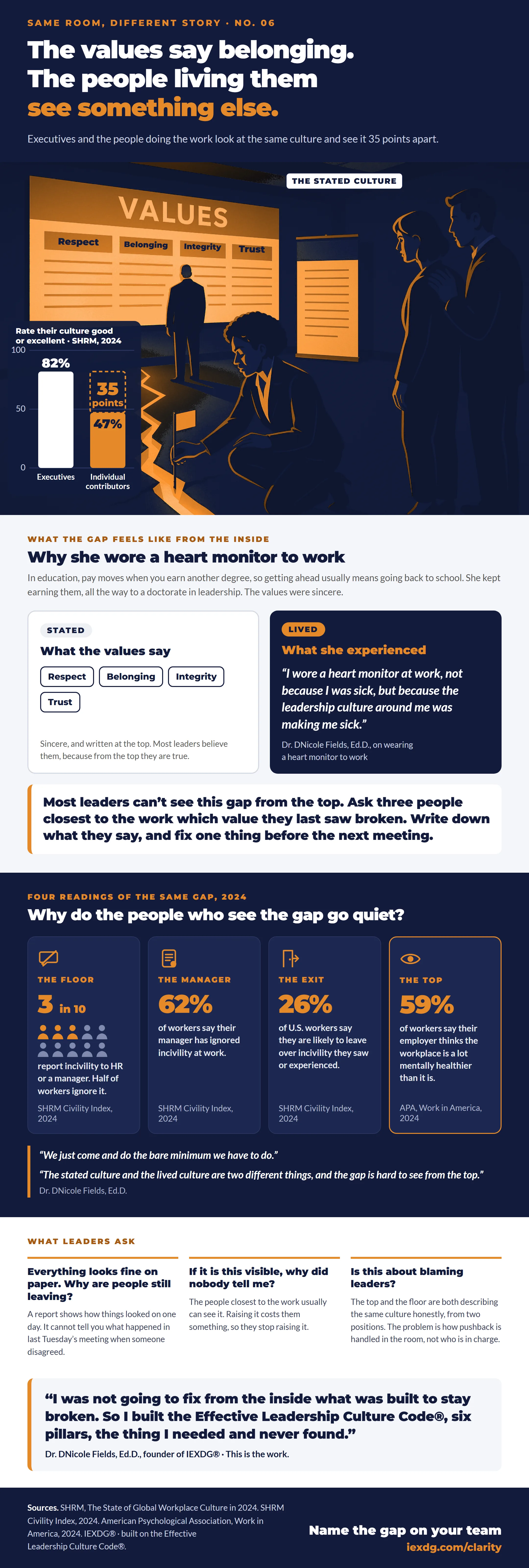
In SHRM’s 2024 research on workplace culture, 82 percent of executives rated their organization’s culture good or excellent. Among individual contributors, the people doing the work, 47 percent did. That 35 point difference is the gap this series is about, measured at the top and on the front line.
Inside your own organization it does not arrive as a percentage. It arrives as the person who stopped speaking up in March and resigned in June, and as the months you then spend recruiting and training someone to replace them.
Text version of this infographic
The values say belonging. The people living them see something else. 82% of executives rate their culture good or excellent; 47% of individual contributors do. That is 35 points lower where the work is done (SHRM, 2024).
Why she wore a heart monitor to work. In education, pay moves when you earn another degree, so getting ahead usually means going back to school. She kept earning them, all the way to a doctorate in leadership. The values were sincere. What the values say: Respect, Belonging, Integrity, Trust. They are written at the top, and most leaders believe them, because from the top they are true. What she experienced: “I wore a heart monitor at work, not because I was sick, but because the leadership culture around me was making me sick.” Dr. DNicole Fields, on wearing a heart monitor to work.
Most leaders can’t see this gap from the top. Ask three people closest to the work which value they last saw broken. Write down what they say, and fix one thing before the next meeting.
Why do the people who see the gap go quiet? Four readings of the same gap, all from 2024. The floor: 3 in 10 workers report incivility to HR or a manager; half of workers ignore it (SHRM Civility Index, 2024). The manager: 62% of workers say their manager has ignored incivility at work (SHRM Civility Index, 2024). The exit: 26% of U.S. workers say they are likely to leave over incivility they saw or experienced (SHRM Civility Index, 2024). The top: 59% of workers say their employer thinks the workplace is a lot mentally healthier than it is (American Psychological Association, Work in America, 2024). In her words: “We just come and do the bare minimum we have to do.” “The stated culture and the lived culture are two different things, and the gap is hard to see from the top.”
What leaders ask. Everything looks fine on paper; why are people still leaving? A report shows how things looked on one day. It cannot tell you what happened in the last meeting when someone disagreed. If it is this visible, why did nobody tell me? The people closest to the work usually can see it. Raising it costs them something, so they stop raising it. Is this about blaming leaders? The top and the floor are both describing the same culture honestly, from two positions. The problem is how pushback is handled in the room, not who is in charge.
“I was not going to fix from the inside what was built to stay broken. So I built the Effective Leadership Culture Code®, six pillars, the thing I needed and never found.” Dr. DNicole Fields, Ed.D., founder of IEXDG®. This is the work.
Sources: SHRM, The State of Global Workplace Culture in 2024. SHRM Civility Index, 2024. American Psychological Association, Work in America, 2024.
Name the gap on your team: iexdg.com/clarity
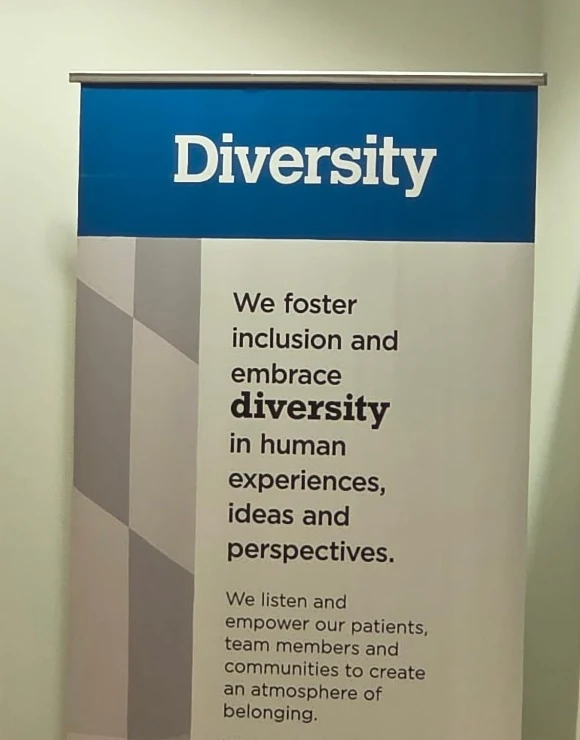
In one lobby, a values banner promises that everyone who walks in will belong. It is sincere. Beside it, the Our Values wall lists the organization's core values. Whether the people who walk past those words every day would say the same is a different question.
The agency and company records earlier in this post show the same gap in government and in business.
▸The bill for the gap arrives before anyone calls it culture. It comes in as a resignation in June and the months spent training a replacement, and the budget files both under other names.
Name it
Tick what actually happened in your organization this year. Each one is a moment from this series. Then put the gap into the words you would use at your next leadership meeting. Nothing is sent anywhere unless you ask for a copy.
Tick what happened and put the gap into words. Your reading appears here, with the next step.
Want a copy to bring to a Clarity Call? One field, and it is a delivery address, not a form.
FAQs
What does it mean to name a culture gap?
Why don’t our numbers show this gap?
Who should name the gap, the leader or someone outside?
How do federal agencies show this gap?
How does this gap show up in corporations?
How much does an unnamed gap cost?
Does this apply to school districts?
Does this apply to associations and member organizations?
Your people answer the Leadership Culture Scan™, thirty questions across the six pillars of the Effective Leadership Culture Code®. Five to seven business days after you sign, you get the read back: where the two stories split in your organization, and the three structural fixes to start with. The scope is set together on the Clarity Call, sized to your organization.
You will not find testimonials or pep talks here. What you get is a reading of your own organization.
Keep reading
Every Organization Runs Two Cultures
Where the series starts, and where it first said the gap has to be named.
Eight Seconds
Why leaders read a quiet room as agreement, and what that quiet measures.
Most Leadership Programs Are Built on Top of a Broken Culture
Why the program was rarely the thing that failed.
If more than one post in this series described your team, that is a pattern, and patterns can be named. A Leadership Culture Intelligence Session™ finds which gap sits underneath the others in your organization and gives you three structural fixes your team can put in place within seven days. It starts with a 30-minute Clarity Call.
A Clarity Call is 30 minutes. No pitch.
Sources. OPM, Federal Employee Viewpoint Survey, 2024 (agency level, supervisor and senior leader indices). Annual reports (10-K filings) of fifteen public companies, 2026, read with the IEXDG claim detector. SHRM, The State of Global Workplace Culture in 2024. Gallup, U.S. employee engagement data, May 2025 (28 percent strongly agree their opinions count). The Neighborhood, CBS, Season 2, Episode 15, “Welcome to the Bad Review,” February 10, 2020. The scene illustration is original IEXDG artwork.
None of this is a verdict on your people. It is a reading of the structure they are working inside. This is the work.